Monday, June 04, 2018

Kitchen Garden Progress Report. 6.4.18

Garlic.  6.4.18

Sweet Corn.  6.4.18
 Most of the kitchen garden is doing well.  The main problems have been herbivores.  I've worked on several solutions, and some of those have helped.

The garlic was browsed even in low wire fencing tunnels.  I thought that was deer, but maybe rabbits.  After spraying with deer deterrent spray, the browsing stopped.  That may have been the size of the plant, and not the spray.  I've given a couple of doses of fish emulsion, and am still watering the garlic plants.  In late winter, I had also spread some Milorganite.  Might have been too much.  The leaf tips have some browning, but otherwise the plants look robust.  I think the crop will be good.  The rotation for the garlic bed:  2 years ago, wild/weed/blackberry; last year, sweet corn, this year, garlic.

The first batches of sweetcorn look good.  I forget the name, the first was an early yellow cold tolerant variety.  The second bath was Trinity.  The third batch was also Trinity, but I don't know if it's growing.  I am using the low fencing tunnels on the sweet corn too, to inhibit browsing, and so far that seems to be working.  The rotation:  2 years ago, squash, last year, potato, this year, sweet corn.
Tomatoes.  6.4.18
The tomatoes are looking good.  these were grown from seeds too.  The location was the duck pen from this winter. Some are blooming and have small green tomatoes.  Many varieties.  I planted them deeply for better dry tolerance.  They had some Epsom Salts earlier to green up the leaves, and some fish emulsion, but now no more fertilizer.  They are fenced in to prevent deer browsing.  The rotation:  Three years ago, Squash.  Two years ago, sweet corn.  Last year, garlic.  This year, tomatoes.
Blue Potato Flower.  6.4.18

Potatoes.  6.4.18
The potatoes are looking better than almost anything else.   They are lush and green.  I used store bought starts, and also sprouted potatoes from the garage.  There are Burbank Russet, Yukon Gold, Blue, and some I don't know from the sprouted ones.   This year I planted in trenches, which I filled in as they grew, because I found that hilling them up seemed to require more watering.  The trenches don't shed water.  The first batch had some frost kill, but otherwise they all tolerated early planting and are growing very nicely.   I did use some Milorganite when planting them, otherwise no fertilizer.  The rotation:  Two years ago, Indian Corn, last year, onions, this year, potatoes.

There are lots of other things.  The rabbits and/or deer have browsed the onions so heavily, I don't think there will be much of a crop.  The low fencing tunnels were not enough to prevent browsing, and the rabbit/deer deterrent spray was minimally helpful.  I still have my doubts about the chili peppers, which so far look stunted.  I've given them some Epsom salts and fish emulsion, we'll see.  The gladiolas, zinnias, and marigolds are looking pretty good now too. 

Young Chestnut Trees Growing Nicely. 6.4.18


Chestnut Precose Migoule Grafted Tree.  6.4.18
 The young chestnut trees are looking good now.  Last winter I planted a grafted tree of Precose Migoule from Burnt Ridge Nursery.  I had asked them for a tall tree, and they had bent over the top instead of cutting it off to fit into the box.  That solution was perfect - I straightened it up, resulting in a 6 foot tall tree.  I splinted it for a few months, but now it's standing straight on its own.  Interestingly, and very rewarding, this tree has a tuft of flower buds on top.

Of the others, the grafted Marivale is about 8 feet tall now, early in it's second season in my yard.  It also has a tuft of flower buds on top.  The little Marigoule, which was only about a foot tall and only grew a few inches, so I moved it to make way for the Preose Migouly, is actually growing nicely, about a foot of lush looking growth so far.  And finally, the seedling from Marissard is growing well too, but no tuft of flower buds.

That last one was my mistake.  I didn't realize, looking in the catalog, that it was a seedling tree instead of a grafted tree, so the possibility of bearing nuts is way out in the future, and it's unknown if it will be a pollinator. Some catalogs offer seed-grown trees from named parents, but those are not the same as the parent and don't bear as young.  But otherwise, the 3 grafted specimens are looking good.  I'm interested in whether the flower buds will bloom - they seem to be taking their time, and so far they all look male.  That's OK, the trees are very young and I didn't expect nuts yet.

Small Marigoule Tree.  6.4.18
I am keeping these trees in tall double-fenced cages, wire fencing for strength and plastic fencing for the finer mesh, to prevent deer from pulling branches through the wider openings in the wire fencing.  So far, these fences are doing their job, and there is no deer damage.  If the trees continue to grow at their present rate, I think the cages can be removed in 2019 or 2020.
Chestnut Marissard Seedling Tree, 6.4.18

Fig Update. Looks like a good year. 6.4.18

Brunswick Fig Tree with Brebas.  5.4.18
The fig trees are doing great this year.  With a mild winter, and early spring, those with breba crops have lots of growing fruits.  The trees that look the most promising this year for big early crop:  Brunswick, Carini, Lattarula, and Desert King.  It's interesting, since Brunswick has not usually done that well.  But it's a big, sweet, delicious fig when it does. There is also a small tree that I started from a bonus cutting a number of years ago, "Sicilian White", with some brebas.

Trees that, earlier, had a lot of brebas that fell off:  Atreano (one remains, which will be the first taste if it matures), Smith, Hardy Chicago.

Most of the new growth on the fig trees, is past the 5-leaf stage.  That's when I tip the new growth to encourage a main crop.  I've been doing that on the daily tree inspections.

Sunday, June 03, 2018

Back on Track. Resuming GrowingGreener Blog! Pawpaw Progress Report. 6.2.18

 I think the hiatus is fully over now.  Live is back to what passes for normal.  I've been continuing to garden, but it's been difficult to keep the blog going.  I think that's done now, so here we are again.

For starters, last month I pollinated as many pawpaw flowers as I could.  NC-1 got pollen from Sunflower, and vice versa.  Of the dozens that I pollinated, there are maybe one dozen little pawpaw clusters growing.  I'm stoked - this is the largest they've gotten for me, ever.  Maybe this will be the year!

Some continue to fall off.  I have been watering these pawpaw trees once weekly, with 2 5-gallong buckets of water.  Maybe that will help them hold on to their fruits.

Monday, April 23, 2018

Planting Annual Flowers, Brussels Sprouts, Collards, Tomatoes. 4.23.18

 Today the soil temperature was 65F.  It might be too early for zinnia and marigold seeds, but I planted some anyway.  Also some nasturtium seeds.

Brassicas, on the other hand, are cold tolerant.  I planted the collard green and Brussels sprouts seedlings into the vegetable garden bed.  I think they will thrive now.  If not, it's easy to grow more from seeds.

Yesterday I planted some of the tomato plants into their outside garden bed.  Again, it might be too
early, but these are extras and they are large enough that I'm finding it a challenge to take care of all of them.

I'm not sure if nasturtiums count as kitchen garden or flower garden.  The greens are peppery delicious in salads or mixed greens.  The flowers are also good.

Saturday, April 21, 2018

Growing Oriental Poppies from Bare Root Starts. 4.21.18

These are poppy plants, from bare root starts that I bought at a big box store in January.  Two of the three plants survived an grew.  They are not as big and lush as the older oriental poppies in the yard, but I think they will bloom in a year or two.

Let's See if Deer eat Petunias. 4.21.18

I planted a "tree ring barrel" with petunias.  Deer are the main gardening challenge in my area.  I'm trying to find plants that they wont eat.  This year the deer pressure is higher than ever, with 2 families regularly crossing my yard. 

The "barrel" is a stack of concrete or cinder block type crescents that connect together into a ring, used to protect trees.  They stack nicely, and in that way make a barrel-type planter.  I like them because they last far longer than oak barrels, and can be disassembled easily and relocated in pieces, much easier than moving a big barrel.

We'll see what happens.  This may just be another deer salad bar.

Carnivorous Plant Progress Report. 4.21.18

Pitcher Plants (Sarracenia) Starting to Grow.  4.21.18

Various Carnivorous Plants Starting to Grow.  4.21.18
Here's a progress report on the carnivorous plants that I bought in February.  Even though they require a different mindset, compared to most other plants, they seem to be taking off.  Each plant is growing at its own rate.

The main points that I have learned so far, are that these carnivorous plants want wet feet at all times.  So I'm keeping them in trays of about one inch of water.  The water can't be high mineral, so I'm using rainwater.  The need to be outdoors if possible, so they are.  They do not like being fertilized, so I'm not.  My source, and much more complete instructions for the beginner, are found here.  The author is my friend Jacob Farin.

An aside, I wrote a blog post on my learning-about-carnivorous-plants blog, regarding the neurotoxins that some American Pitcher Plants (Sarracenia) produce in tiny amounts.  The toxin is coniine, which is also found in poison hemlock
and which was what Socrates famously drank when sentenced to death in ancient Greece.  It's thought that Saracenia produce the substance to either attract or stun insects in its pitchers, so they die and decompose to provide the plant's nutrition.

Friday, April 13, 2018

Repotting and New Yamamoto Dendrobiums. 4.13.18

Repotting #1.  New Growth.
 I had lost enthusiasm for the Dendrobium hybrids, in 2016, and left a few in the compost pile.  Then I saw they survived the summer, and my enthusiasm renewed.  So I put them back into containers.  This one, in particular, was eaten by slugs that year, and in 2017.  This winter, I placed the bare-cane plant in the sunroom, put some organic slug pellets on the bark chips, and mostly left it alone.  It regrew, mainly keikei (new, removable branches with their own aerial roots), so I decided to pot it into a more appropriate (smaller) size container, with new orchid bark medium.  The roots looked healthy, but didn't fill the pot, so I chose a smaller size container.  A keiki fell off, so I potted that as well.  I don'tt have the label, but by the process of elimination, I think it might be the variety Love Memory "Fizz". I've had it at least 8 years.

As part of this new enthusiasm, I also ordered 4 new Yamamoto dendrobiums, direct from the hybridizer / creater, Yamamoto Dendrobiums in Hawaii.  I chose that route, despite shipping expense, because I thought the plants would be better than from a secondary supplier.  I think I was right.
Repotting #2.  Out of Container.
 I ordered the following varieties:

Mellow Heart "Yellow Mind"

Fancy Lady "Royal Princess"

 Red Emperor "Prince"

Oriental Smile "Fantasy"

The nursery also sent a start of a bonus plant, "
Wave King "Akebono"


Repotting #3.  In New Container, and Potted Keikei.
 I also repotted all of these new plants into slightly larger containers, in the same new bark medium.

Of my older Dendribiums, I don't know the name of the one that was left to founder until I rescued it from myself.  I'm pretty sure the flourishing white one is called Spring Dream "Apollon" and the pale pink one is called "Fancy Angel "Lycee".  
Dendrobiums and Tomato Seedlings.  4.13.18

These do so well with the care that I can give in my climate.  During the spring, summer, and fall, they will be outside in full sun.  I intend to do better this year, and water more frequently, but they survived previous years with rare watering in the summer.  I also intend to give some plant food this year.  It's not organic, but my choice this time is the diluted "Schultz" houseplant food, for convenience and the ability to give with each watering in dilute form.   When it appears that frost will come soon, I move them to the sunroom, give occasional water, and they bloom like crazy.

Sometimes they will also bloom at odd times, which is all the more welcome.

On the Yamamoto site, these orchids are pictured ready for commercial sale.  They are greenhouse grown in Hawaii, and bunched together for dramatic presentation.  In my SW Washington setting, they are not so lush, nor so prolific, and that's fine.  I can't believe how prolific they are, and how beautifully they bloom for me, with such minimal effort.

This being April, the rack also has tomato seedlings.  They are a little bigger than I want this time of year, but will be fine.
Sunroom, South & Southwest Views.  4.13.18

Sunroom, West View.  4.13.18


Friday, April 06, 2018

Tomato Plants. 4.6.18

The tomato plants are growing quickly under lights.  They are a little spindly.  I'm potting them up into larger containers, with potting soil instead of seed starting medium, and moving them into the sunroom, where they get real sunlight.  There is still about a month to go before I plant them in the garden.

Planting Some Columbine Starts. 4.6.18

I saw these columbine starts at the store, so thought I would try them.  I have not tried to grow them from bare root plants before.

The bare root plants looked fairly sturdy.  I planted them per the package directions, in the woodland border.   Deer sometimes eat plants there, and I have had columbines partly eaten by deer, so we'll see what happens.  They were not too expensive, so no loss if they don't work out.

Planting More Potatoes. 4.6.18

 This year I'm staggering the potato planting over about 6 or 8 weeks.  They are not all the same varieties, so it's not a real test of when is best to plant them.  I just don't want to overdo the garden work by planting them all at one time.

This week I bought another package of Yukon Gold potato sets.  They were already quite sprouted.  I planted all of them today, and didn't bother to cut the sets into pieces.
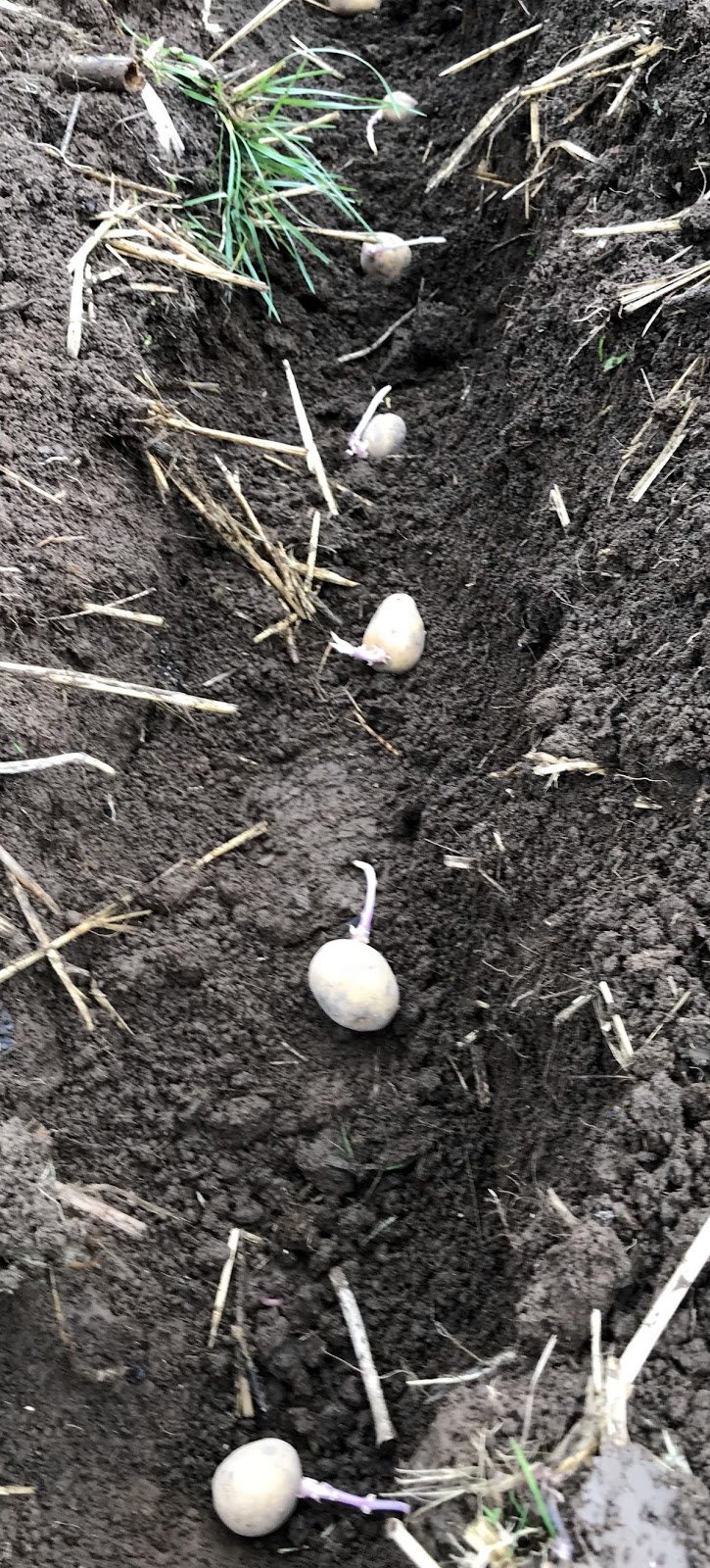
This year they are all going into trenches.  Last year, I  planted more shallow, and hilled up soil around them.  I think that makes for drier soil in summer, hence need for more water.  In addition, voles got into several of them.  This time, we'll see if planting deeper means less watering and less loss to voles.

I'm digging a trench about 1 foot deep, placing the sets into the trench, then covering with a few inches of soil. As they grow, I'll continue to fill in with soil.

I didn't bother to stand the sprouts upright.  I doubt that it matters.

Monday, April 02, 2018

Grafting Apple Scion. 4.1.18

 It was a somewhat chilly and drizzly day.  I had a packet of scion from Fedco.  Earlier this Spring, I didn't have much chance to collect my own scion, due to events beyond my control, but I still like doing some grafting each Spring.

I've been wanting to add some Honeycrisp to the young Winecrisp (plus Milo Gibson plus Sweet-16) tree, so here it is.  I also haven't liked the Rubinette branch on another multigraft (originally Rubinette + Queen Cox + Pristine, but now with a deer-damaged King David + Dolgo + Goldrush + a puny Hawkeye branch).  Rubinette is reputed to be among the best tasting of all apples, but in my hands the apples are misshapen and disease magnets, while other varieties on the same tree are fine.  So I did some pruning and added Prima, another King David to replace the deer damaged branch, and  Fameuse.  I also had a rootstock taken from an underground sucker off an old semidwarf tree, and grafted Fameuse scion onto that as well.
 Over the years, I've dispensed with using wax or Tree-Kote on apple grafts.  I've seen some videos shoing grafters using ribbons cut from plastic bags, which worked well for me last year.  It takes some practice to stretch them tightly around the graft union without displacing the graft, but once in place the plastic ribbons make a tight bandage for the union to heal nicely.  I also wrap the entire scion, but not as tightly.  I do have to watch for growth, so the plastic does not restrict new growth and expansion.
 For the cut, I use a Felco grafting knife.  A lot of modern grafters like using box-cutter utility knife, which can result in a clean sharp blade each time.  I see the attraction but stick to my old Felco.

I cut tags from roadside beer can discards.  I rinse them with lysol in case the people who generously provide the cans (by throwing them out of their cars) have some sort of communicable disease, then cut with kitchen shears and use a paper punch to cut a hole.  I fassten them to the branch, using a loose zip tie.  I watch the tree so growth is not girdled later when the branch expands.  That's not a problem.  I putter around these trees all of the time.


These labels work as well as any mail order label.  I use a ball point pen to emboss the name of the cultivar and date of the graft.

Prima is a Purdue-Rutgers-Illinois hyrid, originally bred to be scab resistant although scab has evolved past that property; best eaten fresh.  Per Fedco, resistant to Fireblight, cedar apple rust, and mildew.

King David is an older variety, info here is from Fedco:  "thought to be to Jonathan x Arkansas Black... 1893. Intensely flavored... Pineapple, tangerine, lemon, sweet, sour, tart, sharp, aromatic and spicy all rush around simultaneously. The medium-sized roundish fruit is very dark solid maroon—nearly black. The fine juicy flesh is firm yet tender and distinctly yellow."

I already had Honeycrisp on M27 rootstock, which restricts growth so much it's never been more than  2 feet tall and has had, maybe, one apple in 5 years.  So I'm trying it on a larger growing multigraft semi-dwaf size tree.

Fameuse is also known as Snow.   I already have a graft of Fameuse on another tree, but it doesn't amount much yet and I want to give it a good chance.  Fedco describes Fameuse as originating in Quebec before 1700. "The 1865 Department of Agriculture yearbook sums it up: “Flesh remarkably white, tender, juicy"…deliciously pleasant, with a slight perfume… Medium-small roundish ruby-red thin-skinned fruit." and possibly a parent of McIntosh.

Saturday, March 31, 2018

Seedlings - tomatoes, peppers, some brassicas, and onions. 3.31.18.

 The tomatoes, peppers, and brassicas germinated nicely.  They are under lights in a West window.

I always plant several seeds per cell.  I thinned to 1 or 2 plants per cell.  When they are a little larger, I may separate some into 2 plants for further growing.

The Brassicas (collard greens and brussels sprouts) are a little leggy.
 I may try again outside.

The onions seedlings that I started 2 months ago didn't do as well.  I was not able to give them the attention that I wanted to then.  Still, they look OK, so I planted them in the garden bed. 

Tuesday, March 20, 2018

Yamamoto Dendrobium nobile in Bloom. 3.20.18

These are Yamamoto Dendrobium nobile hybrid orchids that I've had for, maybe, 10 years. During the summer, I just sit them under a tree. During the winter, I keep them in the sunroom, although any sunny window would do. This is when they bloom like crazy. I gave them a little diluted general plant food in January. Super easy to grow and maintain.


Sunday, March 18, 2018

Daffodils in Bloom. 3.18.18

 Full bloom time for dafodils. Each fall I buy a few bags of bulbs and plant them in random acts of daffodil planting. You never know where they will come up. Planting them is an act of faith, that winter will come and go, and we'll be here to see Spring once again.


Friday, March 16, 2018

Crinum Bulbs. 3.16.18

These were at Costco.  I bought them on impulse.   I had Crinums in the old yard in Vancouver, surviving at least 15 years, and the yard in Battleground too.  They come up every year, bloom for a while, and disappear.  The remind me of Lycoris, which I have never been able to establish. 

I planted them in a container with existing lilies.  Their flowers are transient, but nice.  We'll see how they do.

Venus Flytrap. Cool Stuff.


This is an experiment to see if I can embed videos.  This one is from Youtube, not something I filmed or grew.  It shows a Venus Flytrap eating a fly.  These plants have their own kind of nerve-like responses, and grab their prey after a specific number of movements.  I couldn't figure out how to embed this even cooler video from NY times, but here is a linkScienceline describes how the plants create electrical impulses from their trigger hairs, that serve as mechanosensors, back to the mechanical energy to snap shut around their prey.  The scienceline link also shows a Venus flytrap catching a small frog.

Inspired by my friend Jacob Farin at the carnivorous plant nursery, Sarracenia NW, I've started a new carnivorous plant blog "Beautiful Carnivorous Plants" also on the blogspot platform.

Thursday, March 15, 2018

Plum Bloom Times. 3.15.18


Sweet Treat Pluerry.  3.15.18
It's hard to find overlapping bloom times for fruit trees. Many of the plums and hybrid plums need a pollenizer, but that only helps if they bloom at the same time.  In addition, for areas with late frosts, it's better to plant cultivars that have later bloom times.

So far this year, the following are in bloom at the same time.  These are early bloomers:  Sweet Treat Pluerry (hybrid plum / cherry with some peach and apricot in its ancestry), Crimson Spire ornamental plum (small but flavorful fruits), Hollywood plum, and Shiro plum.  My multigraft is blooming too, but I don't know the main variety - I think it's a pluot.  Methley plum is not quite open now.  Nadia Cherry/Plum is also on the verge, with a few blossoms open.

I removed some blooming twigs from Hollywood and Crimson Spire, and placed them into the branches of Sweet Treat, to improve the chances of pollination.  There are no honeybees around now,  but there are lots of tiny pollinating insects within the tree.  Since they don't appear to fly from tree to tree, I added those branches to improve the chances of good pollination.

Starting Seeds. 3.15.18

 Now the seeds are tucked away into a seed starting tray.  I like to start peppers now or a little earlier, and tomatoes a little later, but there is flexibility and you never know what the weather will do.

This time I tried 3 different types of sauce tomatoes, which I process and freeze in the summer and freeze for winter use.  I go through a lot of those.  "Roma" and "San Marzano" always seems to have a lot of blossom end rot, which none of the others have.  Last year I added more lime, but there was still blossom end rot.  So this year I'm trying 3 other types of paste tomatoes: "Big Mama" hybrid from Burpee, and "Ranger F1" and "Heinz 2653" from Territorial seeds.  I'm holding on cherry tomatoes, because there are always lots of started plants of those in the Spring anyway.  There are also my favorite, "Better Boy", and some others for early crop ("Beaver Lodge 6808 and Glacier") which did seem earlier last year, and some experiments.

 For peppers, my favorites last year were the Jalapenos, which were productive and earlier than some of the other chilis. I'm trying a different one, sold as "Early Jalapeno",  I had too many cayennes, so just one cell of those, and Sweet Banana, Bird Thai, Mini Bells, King of the North, Peter Pepper, and Tabasco.  I think the Tabascos are later but would like to make Tabasco sauce this year if they do produce.

I also threw in some hybrid Collards (Hi Crop F1) and Brussels Sprouts (Franklin F1).  I've never grown Brussels Sprouts before, and I don't know when they are best planted, but it wont hurt to experiment.


Wednesday, March 14, 2018

Meyer Lemon. 3.14.18

I've had this Meyer Lemon plant since about 2001.  It's never grown very large.  The container is a wooden box.  The soil is a normal potting soil.  I have given it a plant food for acid-loving plants, from time to time.

During the summer, this plant is on the deck in full sun.  During the winter, I keep it in an unheated bedroom, with a South-facing window, although it's not in the window.  I rarely water it in the winter, maybe once a month.

Currently, there are dozens of flower buds, and a few ripening lemons that set last summer.  These lemons are delicious.

Plums in bloom. 3.14.18

Hollywood Plum.  3.14.18


Hollywood Plum (pink flower) and Shiro Plum (white flower) in full bloom. Unless there's a late frost, it looks like there will be a bumper crop of the world's best plums this year. Hollywood is deep purple, inside and out. Shiro is yellow, super juicy, and super sweet. 

From what I've read, neither of these cultivars require a pollination partner.  Since I have them planted near each other, I can't say whether that is true.  Both are on the North side of the house, not in full sun, and are still incredibly productive and trouble free.

Sourdough Cast Iron Skillet Pizzas. 3.13.18

Pizza Pizza! Not about gardening, except for the Roma tomato sauce.  Back on track with sourdough crust, cast-iron skillet pizzas with home grown Roma tomato sauce. These crusts take a long time to rise, starting in the morning for an evening pizza. I might experiment with a faster yeast crust, or a hybrid for more sourdough flavor, but they are worth it. Time to start Roma tomato seeds today, too.

Sunday, March 11, 2018

Sourdough bread with Jalapenos. 3.11.18

Since Ning had his heart surgery, I quit adding cheese to the breads. This loaf is sourdough, with jalapenos sauteed in olive oil, plus 2 tbsp olive oil. I don't miss the cheese, and love the flavor and texture. I've been feeding and using and regenerating this sourdough starter for more than a year now, and it's still excellent.  Often, I use at least 50% whole wheat flour, but sometimes I just use unbleached bread flour.