Sunday, September 22, 2013

More Figs

Sal's Fig (left) and LSU Tiger Fig

Eyes of LSU Tiger (top) and Sal's
 First fig of the year for Sal's fig.  Not much on the tree this year.  During the Spring, new growth was damaged by a late frost.  So it had a set back and late start.

The LSU Tiger fig was started from cutting in Jan or Feb.  Nice to get a fig the first year.  This is the second fig.  The first was eaten by an animal.

I haven't been posing photos of the fig "eyes".  These are small, open eyes.  Potential for ants to enter, or rain if they point upwards.  But these pointed downwards.

Sal's was smaller, darker, sweeter, and more flavorful, of the two.  Both were good. 

I read, it takes a year or two for trees to produce full flavored figs.  So next year they may be sweeter or more richly flavored.

I'm pleased to have figs the same calendar year that I started the cuttings.  Even if it's only for a taste.
Sal's (left) and LSU Tiger

Gardening for the Winter. Multiplier onions, Flower Bulbs, Tree Protection.

Multiplier Onions about to be planted.

More Daffodils for the yard.
 The Yellow Potato Onions are now planted for their winter "incubation".  The roots and tops grow during the remainder of fall, then settle in for winter.  Most were the very big size this year, leaving fewer small starts to plant.   I planted about 25 sets, with half being large - to make multiple small sets, and half being small - to make large onion bulbs.  They grew very well last year, with the September - planted ones growing better than later - planted.

One also made topsets.  I planted those as well.

The Egyptian Walking Onions are growing roots and tops.  Fast start.

This Daffodil mix brings the # of bulbs planted this fall to about a hundred.  There are about 150 more to plant.  It sounds like a lot, but they are quite easy to plant.

I made 5 tree - guards so far.  This year I am experimenting with hardware cloth.  These are /12 inch mesh.  I think I'll buy 1/4 inch mesh once I've used up this roll.  Based on the web sites I've read, 1/4 is superior for vole exclusion. 

The ginkgo may not need protection.  Ginkgo trees are considered deer and rabbit resistant.  But no harm in a little protection.

I also have tree wrap saved from last year.  Tree wrap may seal in moisture, which could encourage fungal infection.  So I am not as enthusiastic about that.  On the other hand, tree wrap is easier to apply, compared to hardware cloth.
Varmint Screening for Crabapple Tree


Varmint Screening for Ginkgo Tree
The websites often state the hardware cloth should be partly buried.  However, that would mean damage to shallow roots.  So far, animals have not under-mined trunk protection.  If they do, I'll have to consider more secure options.

Saturday, September 21, 2013

Bearded Iris Beds. Cleanup and getting ready for Winter.

Historic Bearded Iris Bed #2
 Iris Bed #2, mostly historic irises, almost set up for winter.  I'll harvest the big basil plant, and remove a ground cover catmint that is growing too well, and it's ready.

I had grown marigolds and sweet alyssum from seeds, along the front and back edges.  Those overgrew.  Nice for a few months.  Now with rains starting, they shaded the irises to much, and competed. So I pulled out the marigolds and sweet alyssum.  I fed them to the hens.  The hens seemed to like them.  Those flowers, then, will be eaten second hand, as eggs and 4th hand, as composted chicken poop used for vegetable garden.  Nothing goes to waste, if I can avoid it.

Bulbs for the Iris beds
Iris Bed #3
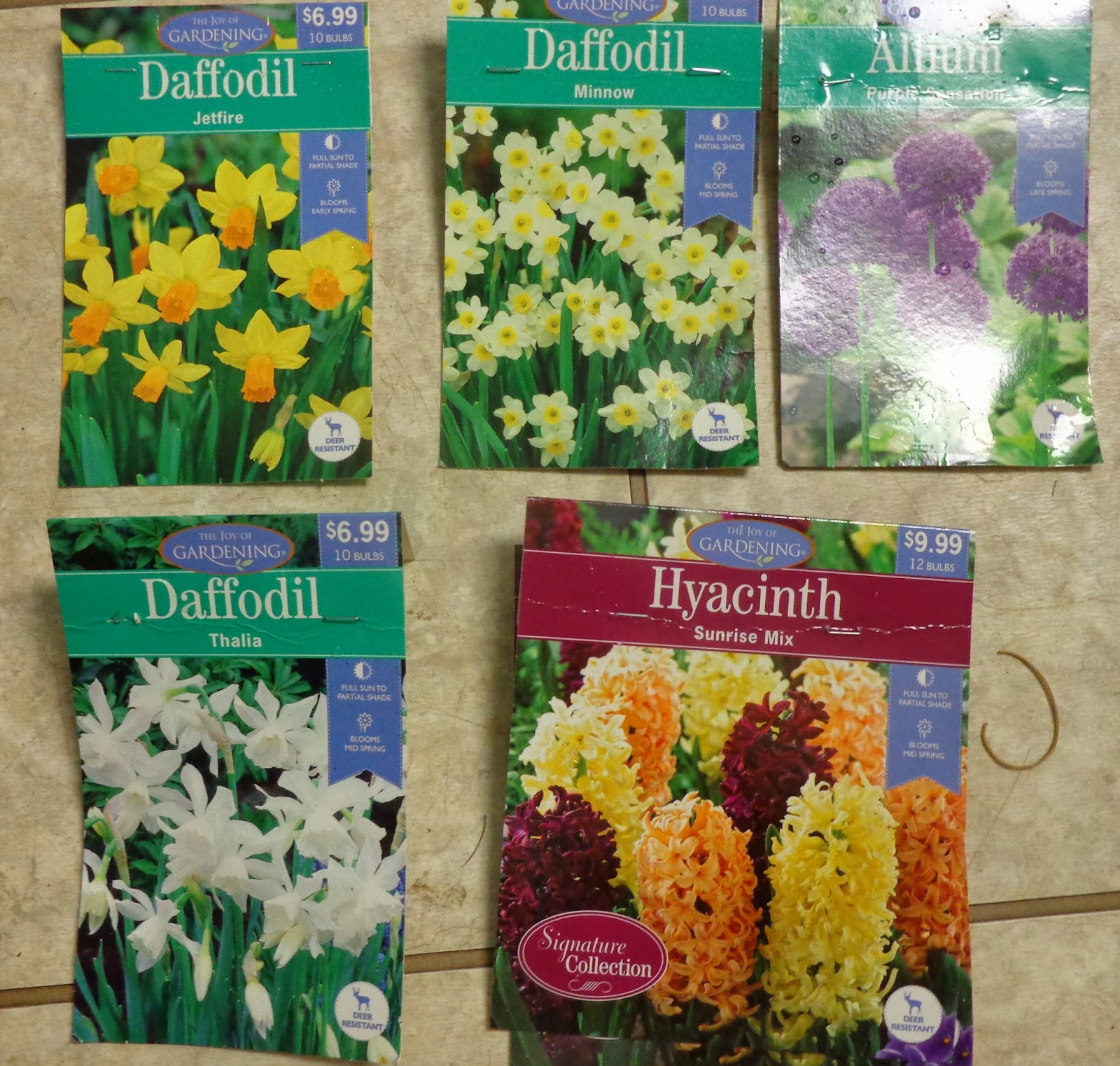
 All of these bulbs were labeled as deer resistant.  Checking the internet, they are also listed as rabbit resistant.  I planted them in clusters among the irises, in beds #1 and #2, and in rows along the edges.  The hyacinths are "Sunrise Mix", the Daffodil / Narcissus varieties are "Thalia", "Jetfire", and "Minnow".  The Allium is "Purple Sensation"  That might be too big, but there are only a few.

I also planted some bulbs I think might be Camassia - not sure.  I dug them up and left them sitting under a tree.  Or they could be a big Allium.  If they grow next year, I'll know.

I don't think these will compete much with the bearded irises.  They will add color in later winter / early spring, when I need it.  Before the irises bloom.
iris Bed #3

Pepper Based "Critter Ridder"
 As for Bearded Iris Bed #3, that is mainly established clumps of modern varieties, I moved from the Vancouver yard.  There are still chili pepper plants from the bed's previous life as a vegetable bed.  Those can stay until they are killed by frost.

I dug out one of the catnip plants, and moved it to the bee garden.  Two or 3 others to go.  Also the chives.  The chives were much more vigorous than I expected.  Both big and competing with the irises.  I think the borage will only last until frost, too.  Not sure.

Along the western edge, are scallions I planted from seeds, this spring.  I think.  They might be multiplier onions.  I filled in, between them, with more multiplier onions.  They will be pulled for cooking, this fall / winter / spring.

A few more plants to remove, then it will be all about the bearded irises, with a few  other plants in between.

Then there's the mole problem.

Bearded Iris bed #3 has been troubled by mole digging for a couple of months.  A few weeks ago I added "Critter Ridder" to the soil, and on top the soil.  I thought that worked.  But today there was a new mole hill.  So I added more.  "Critter Ridder" has a pungent, peppery smell, both black pepper and capsaicin pepper. 

For the newest raised bed, I'm using 1/2 inch steel hardware cloth, instead of chicken wire, bottom.  Maybe that will be better.  Or maybe, the mole climbs over the side.

I don't know if it's the moles.  Several of the iris rhizomes, planted at the soil surface, are now fully buried.  I dug a few out and replanted higher.  It's possible the rhizomes pull themselves deeper.  Or the moles undermine them, and they sink.


Apiary garden / Bee garden

Bee garden

Pink sedum

Pink sedum
Today I added a few plants to the bee garden.  I bought some a couple of weeks ago - some coreopsis starts, and a Caryopteris plant.  I think those were from the marked-down table at Home Depot.  I've been watering them so they don't die.  Now they are planted.

I also moved some very large chive bunches.  I think the bees should like the chive flowers.

I moved the first of several catnip plants.  They, and the chive plants, are much too big for the iris beds.  The bees seem lukewarm about the catnip flowers, but they did forage them a little.

Not much foraging going on today, as far as I can see.

The pink sedum was a stray plant in a border at home.  I don't recall buying it.  It's probably a volunteer.  Maybe a seedling from Autumn Joy.  The flowers are white with pink center.  Nice.  The plants were very lanky  and floppy.  I suspect that is due to the shady / north exposure.  Next year, in full sun, maybe it will be more compact.

Thinking about next year.  I'll put down some sort of underlayment to cover the grass.  Newspaper or brown paper.  Cover with straw, or chopped tree trimmings if I can get them.

Also want to move more Hyacinthoides hispanica from the yard at home.  They naturalized there.  Fairly easy to dig up and move, if caught at about 2 to 4 inches tall.  Once in place, they don't appear to miss a beat.

Brugmansia.

Brugmansia and Charlie

Kitchen Garden

Today...

I picked a bowl of ripe figs.  Most were Petite Negri and Hardy Chicago.  Two Lattarula.

I picked a big yellow bell pepper.

And a few Thai peppers.
Minnesota Midget Cantaloupe
 The first cantaloupe.  I've been watching for ripeness.  Today when I picked it up gently, the stem detached itself from the vine.  So it's ripe.

The flavor was good.  Tasted just like a cantaloupe.

This is a convenient size.  Like a grapefruit.  It ripened soon enough for us to get a taste.  There are a few more on the fine.  None went to waste.  The chickens like the seeds.
Minnesota Midget Cantaloupe

Butternut Squash
 One of the watermelons developed a big hole in the size.  Then spoiled.  So the chickens got it.  They liked it

Another watermelon is looking almost ripe.  Maybe tomorrow.

The butternut squash is my first attempt at Winter squash.  Nice size for the two of us.

These were I-phone pics.  I misplaced my camera.  The colors are a little off. My hand is not that pink.  But the melon looks right.


Some of the harvest 9/21/13

Tuesday, September 17, 2013

Carini Fig

This was the first ripe Carini fig.  A fig forum member in the East Coast sent me cuttings from his family's heirloom variety.  I started the cuttings in Jan or Feb.

This tree is one of only 2 that produced main crop figs in their first year from cuttings.  The other was LSU Tiger.  That one was half eaten by some animal, and spoiled before I could taste it.

This is not a known variety for the Pacific NW.  That it grew in Pennsylvania and New Jersey, which become colder than here, gives me some confidence.

I intend to protect the tree from some of the winter weather this year.  The new growth is greener than growth on older fig trees, so might be more frost tender.  Plus, there are animals that eat the bark, during the winter.

Nice, big, juice fig.  Mild sweeet flavor, somewhat like Lattarula.  I like this fig, and have big hopes for it next year.

Sunday, September 15, 2013

Planting a Crabapple Tree. "Prairie Fire."


I saw this tree in the sale section at Home Depot.  Not wanting to do the work to plant another tree right now, but it's a good kind of fatigue.  Given that the tree fruited this year, maybe it will have viable spurs to bloom next Spring.   Plus, apples are pretty rugged so it has a good chance to survive.  So I bought this tree.


Crabapple "Prairie Fire" before unpotting.
 I'm not crazy about buying tall trees at the nursery.  I think small trees have a better chance to establish.  However, there's the issue of browsing deer.  So I selected the tallest specimen.  Around 8 feet or 9 feet tall.  A bit lanky.  It will fill in.


Unpotted, hole prepared, added "Plant Success" inoculant.
 I expected this to be a ball-and-burlap tree with compost added to the container, and it was.  Not excessive root growth.

Added some "Plant Success" mycorrhizal inoculant.   This soil has not had chemical treatment for 2 years.  I don't know about prior to that.  Reasonable to try to add back some beneficial microbes. 

The lower branches were sharply bend downwards.  I suspect trauma in shipping and handling.  I removed the worst. left the rest.  Expect to prune branch tips when leaves have fallen.
I researched this variety online.  It is multi - disease resistant.   It has pink flowers in the Spring.  If the flowering time is right, it can serve as a pollen source for other apples.  As a type of apple, it will add to the bee forage.

This variety has small fruits that birds eat during the winter.  Another plus.
Planted, mulched, minor pruning.

Fall Blooming Bearded Iris

This was an interesting find. Last summer I moved some bearded irises from the Vancouver place to the Battleground place.  I haven't kept up with weeding or watering them.  Today I noted one is blooming.  The variety is "Liaison".  Behind it is Buddleia "Lilac Haze" and Sedum "Autumn Joy"
Bearded Iris "Liaison"
The leaves look a bit unhappy.  It's an unusual time to bloom.  We are at the start of rainy season.
Bearded Iris "Liaison"

Figs.

LSU "Tiger" Fig
 This is the first fig from the LSU "Tiger" fig that I started from cutting earlier this year.  There is a red tinge.  The fig was near ground level.  An animal had removed it from the tree and ate out the other side.  As a result of exposure, the inside was somewhat moldy and did not appear edible, so I did not taste it.

This is the first fig of the year from the Battleground place.  The situation for this tree - just a start - is so unnatural, I won't predict what that means for next year.  By "unnatural", I mean the tree was started from cutting in January, given TLC on the deck all summer long, and planted in the ground in late summer.  The big test now - will this Louisiana - bred fig survive a Pacific NW winter?


"Petite negri" Fig tree
 Petite negri fig tree.  from fig forum, properly named "Aubique petite".   Lots of ripening figs now.  Tree is about 13 years from a small twig-sized start.
"Hardy Chicago" fig tree.

Fig harvest today
 Hardy Chicago fig tree.  Fair production now.  I missed some, overripe.  About 10 years from a cutting start.

Also harvesting Lattarula figs.  Those are the sweetest of the bunch.  The fig harvest photo includes a few figs - I had a much larger bowl of figs not included.

Not pictured, yet, is a ripening fig on Carini.  Like the Tiger fig, also on a tree started from cutting this year, and at ground level.  I placed some plastic mesh around the fig last night.  Check today for whether the fig is still there and intact.

Bee forage

Bumblebee on Buddleia X "Peach Cobbler"
I don't see a lot of foraging by the honeybees.

Buddleia - bumblebees like them, and continue to forage.  But not honeybees.

Sedum Autumn Joy and similar - a fair amount of foraging.  I'm glad I moved these mature plants to the Battleground yard.
Sedum "Autumn Joy"

Sedum "Autumn Joy"
Lots of bees on these succulents.

Not much forage remaining on Oregano.  At this point, oregano is no longer a significant source.  Given how much it was foraged earlier, I want to add more, next year.

Anise hyssop is also done.  Coreopsis and Caryopteris are nearly done.

I can't imagine there is much more nectar and pollen remaining.  At this point, the honeybees will need to depend on what they have stored.  If that runs out, I might need to add some sugar water.

Saturday, September 14, 2013

Harvest Early September


Harvest Last Weekend

Charlotte Peach with Yellow Jacket

Pepper barrel
Hawaiian Pineapple Tomato

Fresh Peaches

Today's Catch

Raised Beds. Renovated One and Added a New One. Multiplier Onions.

Kitchen garden, from the west

 I cleaned up one raised bed.  There were some plant starts I no longer wanted.  I saved the row of Egyptian Walking Onions to clean up, divide, and replant.  I planted some at the same time last year with good result.  The cleaned up bed will be Ning's Chinese Cabbage bed.

Egyptian Walking Onions, before planting

Egyptian Walking Onions, cleaned and arranged
 After carefully digging out the onion bulbs here is what remains.  It's enough for about 50 starts.
Egyptian Walking Onions Large plants in place, now for the sets.

I cleaned them up, cut off the tops, split apart the topsets, and planted into rows.  They are about 4 inches apart.  We'll pull out every-other-one for scallions, leaving them a reasonable 8 inches apart.

Now they are planted and watered in.

This raised bed is another "molehill gardening" bed.  All of the added topsoil originates as mole hills.  I go around the yard with the wheelbarrow and a shovel, removing the mole hills.  I keep them in a pile and when constructing a new bed, that is the source of topsoil.  I mix with about 30% compost.  The compost is "yard waste" compost from H&H recycling.  I'm suspicious, some of that yard waste is really demolition waste - they grind up old wooden waste - but I think that's OK.

The molehills are finely ground, light, no clods, no stones, no plant matter.  Since they originate fairly deep, using them brings minerals back to the surface level.  They are very easy to remove and haul to the garden.   I'm not worried about the lawn sinking - stomping down the molehills would not help with that anyway.  

Wednesday, September 11, 2013

Sourwood Tree profile. Oxydendrum arboreum.


I noted in previous post, I bought a fair sized specimen Sourwood tree.  Oxydendrum arboreum.

Sourwoods are native to the Southeastern united states.  They are relatively undomesticated.  In other words, there are few cultivars.  This specimen was labeled, just, "Sourwood Tree".

According to Portland nursery, in this area, the tree is upright, slow growing, with a rounded top appearance.   They grow 25 to 30 feet tall, but in their native habitat grow much taller, 100 feet.  They like an acidic, peaty soil, and should be mulched without much plant competition under the tree.

Portland nursery states when planted in lawns, the tree does not thrive. Since I won't have grass growing up to the trunk, and will keep it mulched and add compost, I hope it will do better.

According to http://forestry.about.com/od/silviculture/p/sourwood.htm, sourwoods tolerate clay soil, and loam, sand, acidic soils.  My soil is a clay soil, somewhat acidic.  Also stated there "Reportedly not highly drought tolerant, but there are beautiful specimens in USDA hardiness zone 7 growing in the open sun in poor clay with no irrigation."


 Pic from wikimedia commons .  Sourwood trees make a great varietal honey.   I will have a beehive near this tree, so maybe there will be a small amount of sourwood honey flavor in the honey. At least, it should feed the honeybees.  Along with the lindens I planted, and the fruit trees, and the herbs and flowers.

Yesterday I raked back the straw mulch, and added a few inches of compost to enrich the soil and feed the tree.

I hope it grows.

Planning for a less energetic tomorrow.

I have much less energy than a year ago.  i don't know how far or fast I will decline.  But I want to continue gardening.  That means planning ahead.  What will I do?

- Get the tree planting done now.  It almost is done - a few minor additions, but the orchard is a complete as it needs to be.  Other trees are just icing on the cake.

- Keep the trees well watered this year.  Water deep and with decreasing frequency, for deep rooting.  Mulch with compost, to make the ground more spongy.  Cover that with straw mulch - cheap, biodegradable, keep the ground moist, keep the weeds down.

- Change the circles around trees, into contiguous rows of trees, for easier mowing.

- The raised beds are almost all done.  Three more.  It takes weeks to build one now, that I put together in a day before.  But once done, they are so much easier to manage, compared to in-ground garden rows.  No tilling.  Weeds easy to pull.  Few weeds - grass doesn't enter from the sides.  Just replenish the compost every year or two.  The higher level is much easier to plant, weed, and pull, compared to ground level.

- Continue to convert to dry tolerant plants and trees.  Watering doesn't just take water, it takes time and is tiring.

- I may need to install soaker hoses or other type of sprinkler in the raised beds, so I don't have to haul around a hose.  Not sure about that yet.

- The tree cages - keep out deer - only need to be built once.  A few more are needed, then they are done.  Mulch keeps weeds under control, nicely, in those cages.


-


Sunday, September 08, 2013

Fruit Tree Order for Spring 2014

From Raintree Nursery.  I've made a habit of ordering way ahead.  Not wanting many additions this time.  Each has a specific reason -

Sugar Cane Jujube - SPRING Ship
Jujube Sugar Cane.  According to the web page very sweet but very thorny.  Raintree states they send 3 to 5 foot trees.  The trees I One Green World sent last year were 1 foot trees - pretty lame.  They survived and grew, and are now whopping 18 inch to 2 foot trees.  Look out Sequoias, your record is about to be broken!  So I want to jump start a little and add a taller one.  Different variety for novelty sake.  It's not clear if they need pollenizers.  According to CFRG, jujubes don't require cross pollenation, but according to Raintree they do.  CFRG states:  "Small to medium fruit which can be round to elongated. Extremely sweet fruit but on a very spiny plant. The fruit is worth the spines!".  Maybe the spines will frustrate marauding deer, or at least annoy them.  Pic is from Raintree site at link above

Q-1-8 peach/Lovell - SPRING Ship
Q-1-8 Peach.  I researched many websites for a late blooming, peach leaf curl resistant variety.  I'm not sure about the late-blooming aspect, but Q-1-8 is described by most as quite leaf curl resistant.  Since I have 2 yellow-flesh varieties, this white-flesh variety will be a novelty.  It takes a few years to start bearing,  and I want to see if I can get enough peaches for a pie, from any variety.  Pic is from Raintree site at link above.  Kind of a cute name for a peach.  Rolls off the tongue....  but if it bears OK, resists peach leaf curl, and tastes good, that's all I need.

PrairieFire Crabapple.  To feed honeybees and provide pollen for other apple varieties.  DEscribed by Raintree as "A disease resistant, upright crabapple to 20' with reddish bronze leaves, pink flowers, and bright red 1/2' fruit loved by birds.".   WSU Extension states "Very resistant to apple scab, cedar-apple rust, fireblight and mildew."  Pics are from WSU Extension.  This might be the one I saw at Home Depot on sale, but that was similar size and I like the idea of buying from Raintree.  Raintree states they sell 4 to 6 foot trees.  If it was 6 foot it would be awesome.    Many of my spring blooming trees have white flowers, so one with pink or red would be a nice addition.