Monday, February 15, 2021

Seedling Progress Report. 2.15.2021

 Here are seedling photos for today and a few days ago.  Most are doing quite well.  Some are still germinating, some probably wont.  I always plant extra for that reason.


The shallots had lower germination than the onions even though they are related and look the same.  Still, there are some.  I added more seeds to cells that had limited germination or no germination.    The Japanese scallions look good.  The celery germinated over a week or so, now quite good.  Eggplants were uneven but there are enough.  Peppers too.  

The colors are weird due to the LED lights.  For some, I had them too close and the leaf tips dried out.  They will be OK.  Some people cut off the lead tips to encourage growth from below.  I don't get it, but at least these will be OK.  These are the bulb or storage onions.  They are growing faster than the scallions and shallots.

The two celery are from Baker Creek heirloom seeds.  They are Utah and Chinese.    There are various peppers, but so far I have a bunch of Jalapenos, a banana pepper, Serrano, and a Thai pepper. I dropped the cell pack for shallots, so now replanted some.

These are the two apple seedlings so far.  Both are from the same apple, a Calypso pollinated by columnar Golden Sentinel. Interesting, one is red leaf and other is green leaf. I had stratified them, wrapped in moist paper towel, in zip lock, in fridge, since about August.  I had to change the paper towel a couple of times due to mildew.  I planted these seeds in cells that had pepper seeds that did not germinate.  Then in one, the Thai pepper seeds germinated anyway :-)  I can separate them later.


Here is my seed starting setup so far.  I turned off the warming mats, since the seedling have germinated.

The view from outside today.


Some plants I brought in last fall.

This marigold, I dug up in the fall and planted in a container in potting soil.  It was a volunteer and has been blooming all winter long.

I've dug up this geranium every fall for about six years.  Maybe longer.  Sometimes I let it dry out in the garage.  This year I kept it going in the sunroom.  Sometimes it blooms.

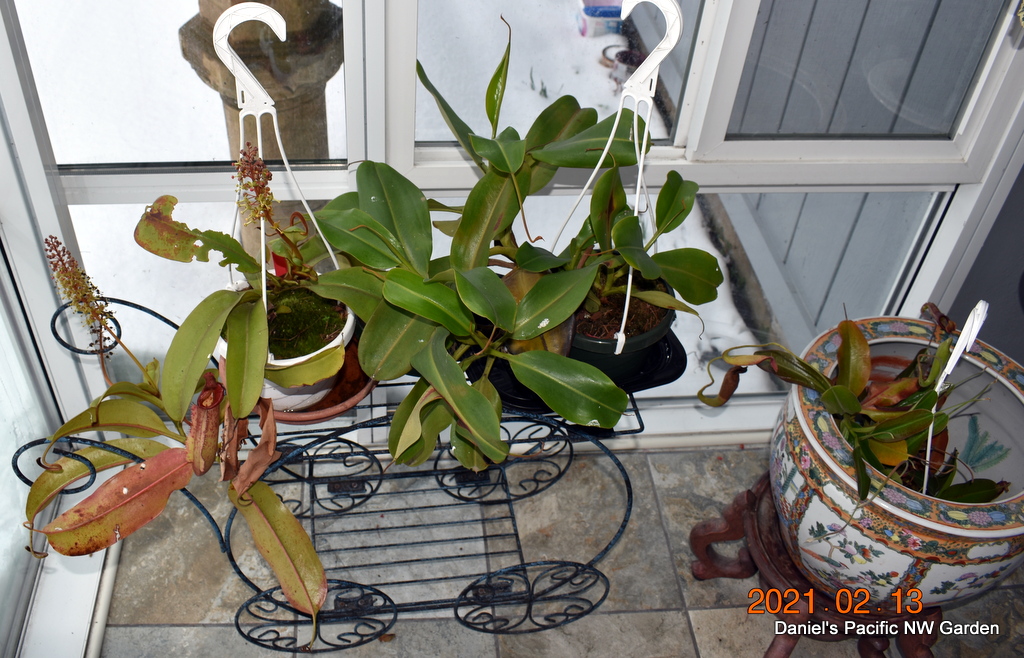
The nepenthes have suffered because I've been sick several times this winter, and they need more water than I gave them.  Some are OK.


Saturday, February 06, 2021

Apple Ripening Times. 2.6.2021

I decided to label my apple varieties as to when they ripen.  I usually can't remember. If I add a tag, then I can look at that.  I haven't decided on what the tag will say yet, maybe month + week so, for example, if they ripen in Mid Aug, the tag will say A2-3  or something.

The dates and summaries (such as "late summer") depend on so many factors, they are not etched in stone.  In any region, there will be warmer and cooler pockets, different elevations, and effects of large bodies of water, or not.  In any given year, there are warmer and cooler years, some more sunny, some with more or less rain.  How many warm days in a given summer may be an effect, as well as how long the summer days are - longer, but cooler, in the Northwest compared, for example to the Southeast.  Still, a super early apple such as Gravenstein ripens in Aug, and a super late apple like GoldRush ripens in Nov or so.

Sources will be listed below.  I decided to group the apple varieties fairly broadly, and base on as local a list as I could.  But also with info from other sites, because many are not listed in a particular book or site.   The dates after the apple cultivar name are the date that cultivar was created, discovered, or introduced, according to the various sources. 


[Edit - I originally had Winter Banana, a late apple, here.  Porter was my intent, it's early.]


Late Summer

Akane [1930s in Japan]- Aug - Mid Sept (Y), Early- Mid Sept (MK)

Gravenstein [1600s] - late Aug (J), Summer (Y), Early Sept (MK)

Porter [ca 1800] - Aug (South)-Sept(N England) (J), Late Summer (Burford)

Pristine [1974] - Summer (B), Aug 25-30 (S), Early - Mid Aug (MK)

Zestar [1990s] - Late Aug (Y), Aug 10-20 (S)


Fall

Airlie Red Flesh [before 1960] - Sept - Oct (J), Fall (B)

Fameuse [1700s in Quebec]- Sept (Y)

Honeycrisp [1960] - Aug 30-Sept 15 (S), mid Sept - Early Oct (MK)

Jonagold [1968] - Oct 5-15 (M), Sept-Oct (RJ),  Fall (B), Mid Sept to late Oct (Y), Late Sept to early Oct (MK), Sept 10-15 (S).

Jonathan [1790s] - Early Oct (M), Sept-Oct (J), Fall (B), Mid Sept to Mid Oct (Y), Sept 10-15 (S).

Liberty [1955] - Oct 10-20 (M), Mid Fall (B), Oct (Y), Sept 10-15 (S), Early-mid Oct (MK)

Prima [1967] - Early - mid Sept (MK)

Priscilla - [1961] Early Fall (B)

Rubinette - [1964] Last half of Sept ( ) , Early Oct (Y)

Sutton Beauty [1757] - Fall (B)

Sweet Sixteen [1973] - Sept 19-27 (M), Sept (J), Fall (B), Mid Sept (Y) Aug 30-Sept 15 (S)

Winecrisp [1990] - Sept 30-Oct 10 (S)


Late Fall

Baldwin [1740] - Oct (J), Late Fall (B), Late Sept - Nov (Y)

Black Oxford [1790] - Early November, long keeper (J), Late Fall (B)

GoldRush [1972] - Nov & keeps very well (J), Fall (B), Oct-Nov (Y), Oct 20-25 (S)

Keepsake [1978] - Oct 10-12 (M), Oct & keeps well (J), Late Fall (B), Mid Sept-Mid Oct (Y), Sept 10-15 (S).

King David [1893] - Late Fall (B), Oct (Y)

Macoun [1909] - Sept-Oct (J), Late Fall (B), Late Sept-Oct (Y), Sept 10-15 (S) 

Opalescent [1880] - Late Fall (B)

Winter Banana [1876] - Oct, keep to Dec (J), Late Sept - Oct (Y)


Sources

B = Tom Burford.  "Apples of North America" ( I think East Coast)

 J = Rowan Jacobsen, "Apples of Uncommon Character" (I think East Coast)

M= Manhart.  "Apples for the 21st Century."  W. Washington and W. Oregon resource.

MK  = Moulton and King, Fruit Handbook for Western Washington.  WSU Mt Vernon Northwestern WA Research and Extension Center.  

S = Stark Brother's Nursery, on line information (Missouri)

Y = Roger Yepson.  "Apples" (Possibly NY State?  I'm not sure)


Looking at this list, this is a lot of varieties!  I must be crazy!  However, each year I obtain some scion and graft to existing trees, so each tree is a multigraft.  Some have a half dozen varieties.  Most of the varieties are on 8 dwarf or semidwarf, multigrafted trees.  That does not include the new minigrafts, espaliers, and columnar trees that will be much smaller.  Also not included, because they are such new varieties, are the Cosmic Crisp, or the red flesh, Redlove apples, Calypso, Era, and Odysso.  The list also misses SummerRed, Grenadine, Prima,


Since it's boring to look at an all-text entry, I included some of the USDA Pomological Watercolors for most of the historic cultivars.  Most have been cultivated from 1700s to early 1900s, with the watercolors mostly being in the first three decades of the 20th century.  Required statement:  "Use of the images in the U.S. Department of Agriculture Pomological Watercolor Collection is not restricted, but a statement of attribution is required. Please use the following attribution statement: "U.S. Department of Agriculture Pomological Watercolor Collection. Rare and Special Collections, National Agricultural Library, Beltsville, MD 20705"  The abbreviated years are for the 20th century - ie, 1913, not 2013.


Tuesday, January 12, 2021

First Seed Starts Of The Year. 1.12.2021

 Today I set up the LED Plant lights on the plant stand, so they will be ready when the seedlings germinate.  I still need to construct a wider shelf.  The first seedlings are onions, which do well started now; peppers and eggplants, which seem to need to longest head start.  I think last year I started peppers in March but it might have been April.  The pepper crop was quite late.  Their raised bed is already set up, which is a nice feeling.

Here is a view of the LED light set up, taken from below.  The light colors do not come at all true in the photo.


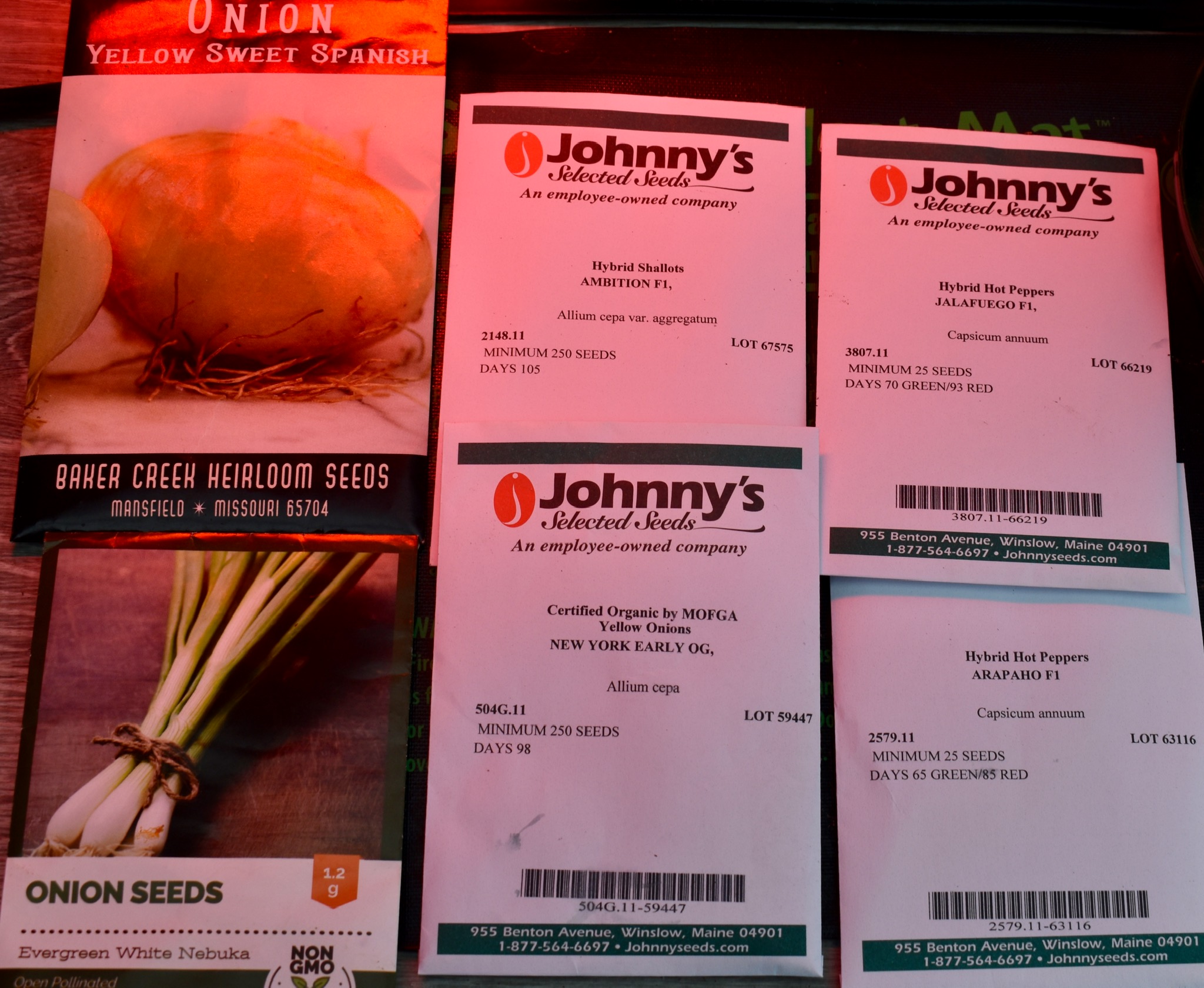
The seeds I started today.

Onions - Yellow Sweet Spanish (heirloom), New York Early, and Evergreen White Nebuka scallions.

Shallots from Seeds- Ambition F1.  I have not tried growing shallots from seeds before.

Peppers- Early Jalapeno, Serrano, Jalafuego F1 hybrid, and Arapaho F1.  Tomorrow I may get out some old seeds for others.  There is room on the mats.

Eggplants-Long Purple and (I forget) Black.  These are old seeds.

I like using the little mushroom containers from the grocery store, as holders for seedling sis packs.  They are more sturdy, and hold water.  The size is perfect.  I have them covered with plastic wrap, and they are on seed starting warming mats.


Some of this year's new seeds are from Johnny's Selected Seeds.  They are located in Maine, so my guess is their varieties should be good for Northern gardens.  Also some from "Seeds n Such" which I have not tried before.  They had several that I could not find elsewhere, and their prices were good.


Sunday, January 10, 2021

Propagating / Transplanting Oriental Poppy. The Result. 1.10.2020

Back in 2000 or so, I grew brilliant red oriental poppies from seeds.  This was an homage to my grandfather who grew them.  I remember him saying that they don't transplant easily.  That might be a false memory, so long ago.  A few years ago, I tried transplanting the mature oriental poppy plants when they were dormant.  The roots were woody and brittle, and broke off under ground.  I planted them  any way, and they grew and bloomed the next year.

Those original plants grew new tops from the deep roots.  Last summer I dug them again, breaking them off as deeply as I could.  I did that when they were fully dormant, mid summer, dried brown stems.  The roots were about 9 inches long.  I planted them in the perennial border around my garden.  

Checking the garden now, there are healthy looking poppy plants at each site where I planted the transplants.  This method works nicely.  I expect they will bloom next summer.


Rufus' New Rain Jacket. 1.10.2021

 Given the gloomy weather, I want Rufus in a more visible color than his natural shadow-black, on our daily walks.  We don't have sidewalks.  I wear bright yellow, so he should too.  I started this jacket last year then set it aside.  The main thing it needed was a belt and belt loops, to keep it from sliding off his back.  Here he is wearing the improved jacket.


Monday, January 04, 2021

Pruning the Apple Trees. 1/4/2021

 There is a role for summer and for winter pruning of apples.  Summer pruning is more dwarfing, but can expose apples to sunburn.  Growth on winter pruned apples can be too vigorous.  There is more time in the winter, and without leaves the form shows up better.

This is Liberty apple on the minidwarfing M27 rootstock.  The tree is 20 years old.  I moved it from the Vancouver place about 5 years ago.  It never did well there, but in Battle Ground  got a new lease on life.  I don't want branches that are too high to reach with a ladder, but also don't want them so low it's hard to keep the soil clean around the tree and hard to get to the apples.  So, I've been progressively removing the lowest branches, and bending the top growth to a horizontal shape, sort of a 3-dimensional Espalier.  I bend those, tie them down for a year or two, then shorten branches that grown one them, in the summer by a Lorette-type approach.  So far it's working OK.

This is the Jonagold.  It's also on M27 but much more vigorous than the Liberty.  Probably because it is triploid.  I'm trying to use the same approach, bending the upper branches to a horizontal position, then prune for spurs in the summer.


I'm not sure about the rootstock on the Winecrisp apple.  It seems to be a dwarf or mid size tree, maybe semidwarfing rootstock.  Again, a similar approach.  I've added some grafts as well, Sweet-16, Fameuse, and Mile Gibson.  So far. the Sweet-16 and Fameuse seem promising.  I'm not sure about the Milo and may change that over to something else.  Anyway, I'm aiming for the same idea, horizontal top branches.  Not pictured.

This was the first tree I grafted.  The base tree is Sutton Beauty, on M26 Rootstock.  I think.  I've added Baldwin, Liberty, Airlie Red Flesh, and Prima.  I'm not impressed with Baldwin and might remove it.  Same for the Airlie Red Flesh, which is good but can be scabby.  No harm in keeping them another year.  This tree remains quite dwarf.  It needs a little more tying down.

These columnar trees are North Pole on M27.  I'm keeping them to single cordon, with spurs about a foot long or less.  They do need support.


 There are still lots more apple trees that need pruning.


Making a Machine Washable Doggie Bed Out of Old Comforter. 1.4.2021

 This was an old comforter I bought at Good Will two years ago for Rufus.  It cost $6.  Most of the dog beds are not really washable and become lumpy and dirty fairly fast, and are quite expensive.  In the past, I used old comforters and folded then for bulk, to make a soft dog bed.  Those can be washed but can be too big for the washer/dryer.  This one was king size, so I never used it.  No way would it fit in our washer.  I didn't notice that when I bought it.

Today I got it out and cut it into quarters, then hemmed the edges.  That made four pillowy minicomforters that can be folded in half or thirds and stacked for the little "prince and the pea.".  Plus, they are a nice washable / dryable size for Mr. Muddy Paws.  I think these will last longer than a bought purpose-made dog bed, and he likes them.

Reuse, repurpose, upcycle, whatever.  Plus cheap.


Raised Beds are Finished. Garlic is Growing. 1.4.2021

 The raised beds are done.  They are all filled with soil mix.  The last one got about 2/3 soil from where the neighbor built a road on his easement on my property.  It's good soil, unimproved and fallow.  That got mixed with some raised bed soil from an old bed that has been improved with lots of compost over the years.  I added some wood ashes and crushed eggshell to the mix.

The middle bed also settled, so got a wheelbarrow of that same soil on top of the prior mix.  I added it on top of the maple leaf mulch, which I want to compost itself.  Both beds will get a leaf mulch for the rest of the winter.  I hope the earthworms will like that and do their thing.

The first bed was planted with garlic after I filled it in Sept or Oct.  These are the big, "Music" garlic, and also some others.  One row had germinated shortly after, but the most did not.  Now they are poking through the soil.  Winter wont hurt them.  Currently they are getting all of the coffee grounds, which in my case is quite a bit.  I used to collect coffee grounds from Starbucks, which sometimes they were nice about and sometimes they were put off by that.  With the pandemic, I haven't been to a Starbucks in a year.  So these are all from my own coffee pot.  They also got quite a bit of compost mixed into the upper soil layers, which I figure they will like.

I also salvaged some garlic plants from an old raised bed, planting them in the new one.  I don't know how they will do.  But if they grow, that's good.  If they don't, nothing lost.


I think these taller raised beds will benefit my gardening a lot.  They don't take nearly the amount of leaning and crouching and back-straining.  They were still a lot of work to fill.  That is an investment into a gardening future.  Having three beds, one gets garlic, one gets peppers and pickle cukes, and one gets scallions and leaf crops, or bush beans.  That makes a good rotation, one year on / two years off for each crop.

So far, I like this style of raised bed better than any other that I've tried.  They are less heavy work to put together.  Boards take less garden real estate than cement blocks, although there are advantages to those.

Squash. Also Don't Use Pyrex to Roast a Squash. 1.4.2021

 This is a Pink Banana Squash.  There were a couple of good ones this year.  This one needed roasting, so it doesn't get a chance to spoil.  This one was about 5 pounds.


I tried roasting it at about 375 for an hour.  Then I heard a loud noise from the oven.  The squash slices were in Pyrex casserole pans.  I've used them many times.  This time, one exploded.  Glass shards embedded in roasted squash all over the oven.  I had to take it apart to remove the glass and clean it.  Of course the squash was also ruined, with glass shards in the roasted squash flesh.


Fortunately I have one remaining Pink Banana Squash to roast.  This time I will use earthenware oven pans.

Finished a Quilt. 1.4.2021

 This is a lap-size quilt.  Or goes on the wall.  I learned a lot with this one, how to quilt it without creases, how to to this patchwork, how to get the binding right.  Next I will make one for the bed, which is the whole idea.  I just wasn't ready before.  I'm thinking to use shades of blues and neutral colors, or I don't know.


Washing the quilt brings out a nice texture, as the fabrics soften up and there is a little shrinkage.  I think it's a beautiful effect.  In fact, I think it's a far nicer look than before washing.