Sunday, June 16, 2013

Home Orchard

Vancouver Brunswick fig before moving 12/12
Vancouver Brunswick fig 6/13

Illinois Everbearing Mulberry
Update on this "Vancouver Brunswick" fig tree that I moved last December.  I thought I might have killed it with the pruning and digging and moving.  Then when it did start to grow, the new growth was killed by frost.

Now it's making a good comeback.  At the Battleground site, this tree has more coarse, darker green, stiffer leaves.  I take that as due to brighter sun and differences in climate.  Maybe the cooler nights, or a difference in fertility.

This tree may not have figs this year.  I don't mind, and prefer that it use it's photosynthetic energy to establish more extensive roots for next year.

From this and the other tree-moving results, I think I can say, now, I know how to transplant trees to a new location.

The Illinois Everbearing mulberry is almost ready for a first crop at Battleground.  Many of the mulberries are changing from green to greenish-red.  Again, as for the fig tree, the leaves are darker and more coarse.  I take that as a good sign. The loss of growth from late frost proved to be minimal.  The tree appears well adapted and established in the new site.  Compared to last year in the Vancouver back yard, there are many times more mulberries.   I forgot to bring bird netting this weekend.  Might regret that.  Would like a taste.

The NC-1 pawpaw is still at it's beginning.  I expect this year the pawpaws will be establishing their roots, more than growing tops.  The other pawpaws are even smaller.  Last year's concern was, did I  kill them by planting here in the Summer.  Pawpaws are reported as needing shade in their first year.  They survived, and are growing, so I'm happy with that.
NC-1 Pawpaw
Mystery Fruit Tree

Sal's Fig

Apple Golden Sentinel
The "mystery fruit tree" was here when we bought the Battleground place.  Initially, I thought apricot.  Then Asian plum.  Now I'm thinking apricot again.  Last year it was defoliated by deer.  I sprayed with repellent, mulched, provided compost.  This year it's almost doubled in size.  Maybe next year it will bloom, and maybe bear fruit, so I will know what it is.

Like the other fruits, the Sal's fig tree has recovered nicely from the last frost leaf-kill.  There are some incipient figs.  Maybe I'll get to eat some this fall.

The Golden Sentinel apple sports one apple.  The tree is only knee high.  I should remove the apple, but I want a taste this fall.  This tree may need to move this fall.  Or not.


Apiary Garden

honeybee on daisy

Buddleia Miss Ruby 1st flower
This weekend I planted two more Ceonathus thyrsiflorus "Victoria" starts.  No pic.  They were in 2-qt containers, in the picked-over and about-to-be-discarded section at Fred Meyer.  $7 each.  With pruning of dead branches, they look a little better.  Planted in the "nursery" bed near the beehive.  Expect they will need to be moved in a year or two when they are bigger.

Daisies and dandelions are blooming.   Blackberries look like they are about finished.  I don't know where the bees are foraging now.  Not a lot of bees on the Ceonathus or blackberries, this weekend.

This is the first flower on Buddleia X "Miss Ruby".  Missed photographing a hummingbird visiting this flower.  No bees on the Buddleia, either.

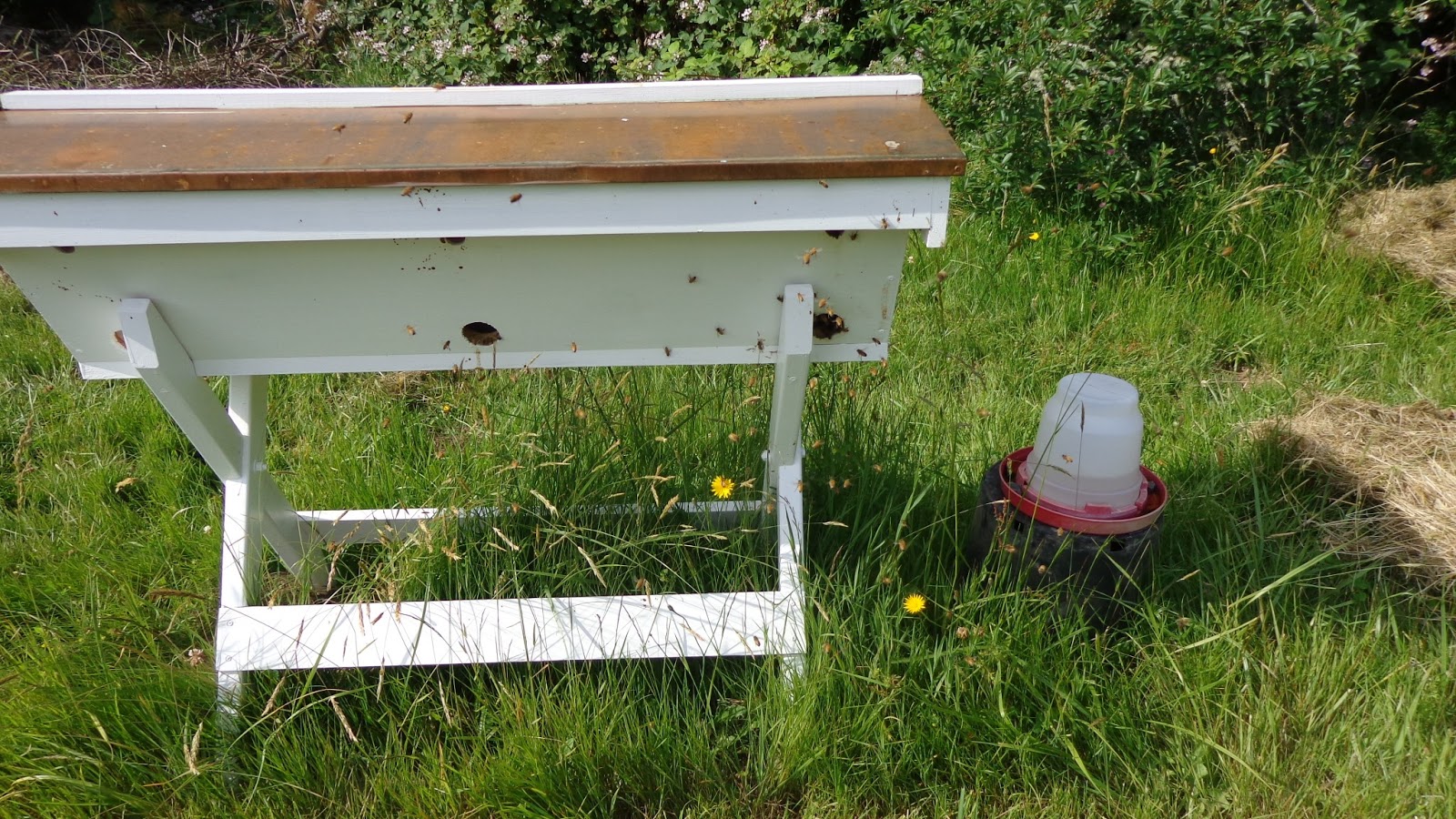
About one month ago I received the second beehive I bought via Beethinking.com.   Put it together, and the top didn't quite fit.  Today I took it apart, trimmed the endpieces, and put it back together.  The top fits now.  Next week, I might paint it.  No hurry.  I probably won't add the honeybees until next April.
Daisies and Dandelions

Honeybees
 Later...

I take back what I said about honeybees not foraging the blackberries.  This afternoon I looked and there are many bees on the blackberry flowers.

The hive is less than 10 feet from the brambles.  Good location, I think.
Beehive

Kitchen Garden. Strawberries and Snowpeas. Planting zucchinis and squash.

Strawberries and Snowpeas
Getting more strawberries and snowpeas.  The individual harvests are small but good enough for two.  We have had several harvests of both, for 2 weeks.

Also a broccoli spear.  I wondered if it was worthwhile to grow my own broccoli.  It is.  More tender and flavorful than grocery store broccoli.

Zucchini seedlings
I planted zucchini seedlings, yellow and green varieties.  Also a butternut squash.  These are seeds I started about 2 weeks ago.  Covered with chicken wire.  Loose.  They grow fast.  I'll have to come up with better protection in a week or two.

I didn't have the ambition to build another raised bed.   So they are in the native soil, plus some steer manure compost.   I have been collecting molehill soil from around the yard.  There should be enough for one or two raised beds, in a couple of months.

Sunday, June 09, 2013

Apiary garden. Shrubs for pollen and nectar.

Sterile buddleia hybrid "Miss Molly"
 I decided not to add more shrubs.  Then I needed something for my mood.  These are chosen as potential sources of nectar and pollen for honeybees and native pollinators.

The sterile buddleia hybrids are noninvasive and are available in nurseries in Portland OR and in Vancouver WA.  They replace the now illegal-Buddleia davidii varieties, which are invasive and rangy.

"Miss Molly" was bought in bloom.  I had it on my deck for a week.  The current flowers are about spent, so I planted it.  This, and the others, should bloom most of the summer and fall.  If we can believe the nursery ads.

"Miss Ruby" is the pollen parent of "Miss Molly".  Both are complex hybrids of multiple species of buddleia.  This plant was not in bud yet when I planted it last month, and is just beginning to bloom.

"Peach Cobbler" and "Blueberry Cobbler" are also sterile complex hybrids.  These plants look the same.  They were hold-overs from last year at the nursery.  I bought and planted them midwinter.  They have more than doubled in size.   Vigorous.  No flower buds yet.

Ceanothus thyrsiflorus "Victoria".  Not many honeybees on this.  The Ceanothus on the neighboring property was filled with honeybee activity, but now there aren't many.  More bumblebees and native bees.

Weigela florida "Lemon Ice"  A pale yellow weigela.  Impulse buy.  That, along with the ceanothus and Feijoa, were the result of my feeling ill.   Better now.  Fortunately there was room for all of these in the apiary yard and orchard.
Sterile buddleia hybrid "Miss Ruby"

Sterile bulldeia  hybrid "Peach Cobbler"

Ceanothus

Weigela "Lemon Ice"

Orchard. Progress Report.

Blackberries

Feijoa / Pineapple guava
 I may need to stretch how I define "orchard".   Since the feral Himalayan blackberries are adjacent, they are included.  At some point they need to be tamed but not yet. They will be a major source of fruit this year.  They are also part of the apiary as a major source of nectar and pollen.   Not many bees on this bramble hedge.  Behind the beehive, there is another bramble hedge where the honeeybees are more active.
Grape Himrod

Grape Buffalo
 Feijoa, also called Pineapple Guava.  Apparently neither name is accurate.  This was from Tsugawa nursery last week.  Nice sized shrub.  No variety name.  That might be a mistake.  Some varieties need a pollenizer, others don't.
Cherry Montmorency

Himrod and Buffalo Grapes survived the late frost and are now growing nicely.  Probably won't be up to the top of the posts this year, but roots should be established.    These were bare root from Fred Meyer or Home Depot. There is also one from Raintree Nursery, same size.

The challenge with grapes will be how to keep rabbits and deer from eating the plants.  Currently they are in cages.

Montmorency and Surefire Cherries.  Both ripening.  Small amounts but it is nice to get some  fruit from our own place, so soon.  The Montmorency was cheating a bit - I bought it this year in bloom at Lowes.  The Montmorency was moved last summer from the Vancouver place, so survived fine and overwintered fine.

Seijo and Nikita's Gift Persimmons.  According to the Raintree catalog, these may not come out of dormancy until late summer or fall, so I feel fortunate to have some growth now.  They look fairly delicate but might be tougher than they look.  Lemon balm is planted in many of the tree circles, including by the persimmons, to reduce risk of animals chewing roots and bark, and attract pollinators.  I may not keep it there if it looks too competitive for the little trees.
Cherry Surefire

Persimmon Seijo


Persimmon Nikita's Gift

Historic Iris & Culinary Herb beds, progress report.

Historic Iris / Culinary Herb bed #2
This weekend I move more irises to the second raised bed.  I learned from last year's experiences.  Moving late Spring / early summer did not result in any negative consequences, and the irises I moved at that time flourished.

The varieties I moved from Vancouver were:  Cherry Garden 1966 (small variety), Pink Bubbles 1980 (small variety), and Gay Parasol 1973 (tall variety).  Any iris more than 30 years post introduction year is considered historic.  That makes me historic too.  I also added Los Coyotes 1992 - not historic.   I planted woolly thyme, which it looks like will stay very close to the ground, which I want.  The marigold sweet alyssum seedlings are about 1 inch tall.
Historic Iris / Culinary Herb bed #1
The first Historic Iris / Culinary herb bed.  Still in Bloom:  Quaker Lady, Iris pallida dalmatica, Shah Jehan, and Iris flavescens.  Iris flavescens is especially florifeorous.

Roman chamomile is too rangy.  After bloom, it will have to go elsewhere.  Greek oregano is also too tall for the small iris plants.  Lime thyme, French thyme, and sweet alyssum are ideal size.

Tuesday, June 04, 2013

Apple Grafts

Apple Grafts
These are the little trees I grafted in March.  Sutton's Beauty and Spitzenberg.  Growing nicely.  With this much of a top, it's safe to say the grafts definitely took.  I'll keep them growing in containers, this year.  Next year they can go into their permanent spots.

I'm very pleased, I created my own grafted apple trees.

All of the pear grafts this year took too.  Next year I might add some more.

Historic Iris Shah Jehan

Shah Jehan 1932
Described as tall and late.  That is accurate.  Nice fragrance.  Good for back row of heritage iris bed.  Has not flopped over but looks like it could.

Sunday, June 02, 2013

Kitchen Garden.

Broccoli

Broccoli in container
 A few minor notes on kitchen garden.

The broccoli is ready.  I didn't know when to harvest.  One of the heads started to open its flowers.  So I waited too long.  Harvested the rest.  Left a few side shoots in case they decide to produce.

German chamomile is blooming like crazy.  The honeybees are not so enthusiastic about this plant.  They are much more interested in Ceanothis.  Blackberries within 10 feet of the beehive are starting to bloom, and honeybees are starting to show interest in the blackberry blossoms.

Okra seedlings are on their cotyledons.  Not bad.  I was surprised they sprouted so soon in  the rainy cool week.

Tomato plants are growing nicely.  No pic uploaded.

Also not pictured, we ate barley soup, with added fresh rosemary, parsley, and oregano, all from the heritage iris / herb bed.  Then today I had eggs with chives, and sliced chives onto left over barley soup.  All very good, great flavor.

We had the first fresh strawberries.  Most were not so good.  Woody.  I don't know why.  I don't think it's the variety.  I've had good strawberries from these plants before.  Maybe it was the deer/rabbit defoliation.  They have mostly recovered from that. A couple of fresh strawberries were perfect.

We had a few more snow peas.  The few plants don't bear enough to cook.  Ate them raw.  Next year try starting them in containers.  To get more plants.
German Chamomile

Okra seedlings

Iris Raised Bed, heritage Irises

Heritage iris and culinary herb raised bed
 Heritage iris and culinary herb raised bed.  Now I wish I thought of this before.  They go together very will

Caprice.  The photograph color is not the same as the flower.  In person is is more of a rosy red, not so blue.  Nice sweet fragrance.  In the literature this is described as a grape fragrance.  That is not far off from reality.
Quaker Lady.  Also a nice sweet fragrance, floral.

Pallida dalmatica.  Also, sweet grape - like fragrance.  Sweeter than grapes.

Sold as Honorabile but Historic Iris Preservation Society states most likely Sans Souci.  No fragrance, which I knew when I ordered this variety.  I liked the appearance, and in person it is better than I anticipated.  Ideal little iris for this bed.  I don't know what I should call it, but leaning towards Sans Souci, since that is probably the right name.

Flavescens.  Also unscented, and also ideal for this bed.

Helen Collingwood.  I think I already posted that so will hold off doing so again.  Also nice floral fragrance.

Iris/herb bed #2 is also coming along nicely.  Both got a dusting of crushed eggshells this weekend for calcium.

Caprice 1898

Quaker lady 1909

Pallida dalmatica 1597

Honorabile 1840 (Sans souci? 1854)

Flavescens

Walk around the yard.

Poppies
Some of the poppy seeds I planted last fall have grown into plants and are starting to bloom.  Most are Shirley poppies.  They are randomly planted around the yard, mostly in tree circles and by fence posts.  Nice sight.

The Rose of Sharon I moved last fall and for much of the winter and spring thought I had killed, is growing nicely now.  I anticipate flowers this summer.  Charlie agrees.

Sambucus nigra "Black Lace" is a pretty large shrub or small tree.  It's an Elderberry.  This shrub counts as ornamental as well as belonging in the orchard.

One ginkgo seed has sprouted.  Of the couple dozen I planted last fall.  Did an animal eat the others? Or slow.  Or dead.

The neighbor's Ceanothus (California lilac) is in full bloom and humming with bees.  Bumblebees, tiny pollinating bees, and honeybees.  I was impressed.  So I went to Tsugawa nursery mainly in hopes of finding a Ceanothus.  Which I did, and planted reasonably near the beehive.
Rose of Sharon

Sambucus nigra Black Lace

Ginkgo biloba seedling

Ceanothus and honeybees

Thursday, May 30, 2013

Happiness


Happiness is the only good.
The place to be happy is here.
The time to be happy is now.
The way to be happy is to make others so.


(pic:  honeybee on avocado flowers, via commons.wikimedia.org)

Tuesday, May 28, 2013

Honeybees

On a chilly am, the honeybees cluster at the hive entrance.

Iris Raised Bed

 Raised bed for heritage irises and herbs.  A couple of irises are currently blooming.  Several more are in bud.  The later ones are from the Spring planted irises from Old House Gardens.

My goal last fall, until now, was for the irises to establish in this location.  They look good.  So now, some minor  maintenance, nurturing, and puttering from time to time, and hope for a more lavish display next year.  I feel fortunate that some of the Spring planted irises did indeed bloom, or will, so I get a taste of things to come.

The little blu-ish iris is Her Majesty.  It's not as blue in person, but bluer than the catalog color.  Effect of soil pH?  Climate?

New raised bed for heritage irises.  Built this past weekend, filled, and moved several irises from places where they had bee stuck due to no good places elsewhere.  The variegated iris is Iris pallida variegata alba.   The other blooming iris is an unnamed Iris I bought from a source in Tennessee last summer.  Slight fragrance.

I also planted herbs from other locations.  Chives, oregano.  Areas the will have irises later, I planted with swiss chard and carrots.  I planted the edges with sweet alyssum seeds.
Helen Collingwood

Night Hawk
Helen Collingwood.  I've been wondering if i would like this one.  I do.  It's handsome and has a mild sweet fragrance.  It has not fallen over in the rain, and the rain has not damaged the flowers, which gives it an advantage over a lot of the fluffy modern varieties.

Night Hawk.  Also a mild sweet fragrance.  Not a heritage variety, but I liked it.  This iris did fall over in the rain.  So I staked it for support.  The color on my computer looks true to the flower.

Bumblebees have been exploring these flowers.  I didn't see any honeybees in them.

Planting Seeds.

Spring Seed Planting
These are the seeds I planted in the past week.

Alyssum and Bonanza Mix Marigolds in the tomato bed.  They sprouted during the rains of the last week.  Also planted alyssum seeds in the border of the new iris raised bed.

Clemson Spineless Okra - Also in the tomato bed.  Clemson Spineless was introduced by Clemson University in 1939, 50-64 days.  That's in an ideal hot climate - possibly 2 or 3 months here if it bears at all.  After one week of rain, I also saw sprouts.  I read that they require soaking and heat.  So I started some today after soaking with 2 changes of water, for several hours.  I also read Okra doesn't respond well to transplanting.  The seeds I planted today I planted in newspaper-lined containers to reduce transplant shock.

Swiss Chard - in empty squares of the iris bed I set up last weekend.  It will be mid to late summer before I add the irises in those spaces.  I don't want to leave it with bare soil.  Space is at a premium.

Petite Yellow Watermelon ( 65-80 days) and Blacktail Mountain Watermelon (65-75 days) - Haven't tried watermelons here.  Starting in containers, today.  Then into raised bed.  Cleared some space in the raised bed, from winter vegetables.  Some of those didn't do well, others have been harvested - radishes, greens.

Minnesota Midget Canteloupe (60-75 days).  Haven't tried these either.  These are a small melon, 4 inches, and the vines are 3 feet long.  May plant them in containers, not sure yet.  Also starting in containers, today.

Japanese Soyu Burpless Cucumber (65 days).  Starting in containers today.  Will find a place for them.

Asparagus Pea (60-75 days).  Starting in containers.  Will need to fine a place for them too.

Parisian Carrot (55 days) and Red Cored Chantenay Carrot.  (70 Days).  Also in the new iris bed, for the same reason.

Also some cleome seeds for Ning's meadow.

Also the last of the sweet potatoes.  One week ago, I discovered what looked like near dead sweet potato starts in the mailbox.  They were there for the weekend.  I cleaned them up and planted the best looking ones in a half barrel.  These sweet potatoes were described as an early variety, good for the North.  The remaining set I placed in a glass of water, with daily water changes.  They also look better, grew new roots, so I planted them today.

Sunday, May 26, 2013

Tomato Bed

Tomato Bed
Tomatoes, planted and ready for some sunshine.  The 3  smaller ones were plants I grew from seeds.  Late start for those.  Also some basil plants.  Last week in this tomato cage, I also planted 2 rows of okra, and edges of sweet alyssum seeds and marigold seeds, which have germinated.