 Neighbor had 2 seedling apricot trees they've been growing for a number of years. They wanted to give them away, so here we are! Nice neighbors! There is some risk - first, I've never been able to get an apricot tree to survive here. Second, seed-grown, no idea what the apricots will be like. Finally, they might need a pollinator. Still for #2, my neighbor has had these outside for maybe 6 years, in containers. I suspect they will be OK. Maybe there is a rootstock issue with the trees that have died? These are seed grown, so on their own roots. As for pollinator, since these are seed-grown, each should be genetically a little different from the other, so they should be compatible. As for the unknowns, we have room for them, and there isn't much risk, so here they are.
This little orchard now has the 2 apricot trees, 2 pear trees, and an American linden (nectar source). Also planned are the 2 dwarf apples I bench-grafted at the Home Orchard Society grafting class, starting to grow. I'll keep then in containers for a little longer before planting in ground.
Neighbor had 2 seedling apricot trees they've been growing for a number of years. They wanted to give them away, so here we are! Nice neighbors! There is some risk - first, I've never been able to get an apricot tree to survive here. Second, seed-grown, no idea what the apricots will be like. Finally, they might need a pollinator. Still for #2, my neighbor has had these outside for maybe 6 years, in containers. I suspect they will be OK. Maybe there is a rootstock issue with the trees that have died? These are seed grown, so on their own roots. As for pollinator, since these are seed-grown, each should be genetically a little different from the other, so they should be compatible. As for the unknowns, we have room for them, and there isn't much risk, so here they are.
This little orchard now has the 2 apricot trees, 2 pear trees, and an American linden (nectar source). Also planned are the 2 dwarf apples I bench-grafted at the Home Orchard Society grafting class, starting to grow. I'll keep then in containers for a little longer before planting in ground.
Sunday, April 07, 2013
Ning planting 2 apricot trees
Neighbor had 2 seedling apricot trees they've been growing for a number of years. They wanted to give them away, so here we are! Nice neighbors! There is some risk - first, I've never been able to get an apricot tree to survive here. Second, seed-grown, no idea what the apricots will be like. Finally, they might need a pollinator. Still for #2, my neighbor has had these outside for maybe 6 years, in containers. I suspect they will be OK. Maybe there is a rootstock issue with the trees that have died? These are seed grown, so on their own roots. As for pollinator, since these are seed-grown, each should be genetically a little different from the other, so they should be compatible. As for the unknowns, we have room for them, and there isn't much risk, so here they are.
This little orchard now has the 2 apricot trees, 2 pear trees, and an American linden (nectar source). Also planned are the 2 dwarf apples I bench-grafted at the Home Orchard Society grafting class, starting to grow. I'll keep then in containers for a little longer before planting in ground.


Friday, April 05, 2013
Home Orchard in Bloom
 |

Euro plum. This tree came with the place. Deer ate virtually all of the leaves. A few new branches grew but it was shot for the summer. That it survived at all is a surprise. The new branch will supply some plums this year. The older branch, which was denuded, I will be happy if it just grows. Looks like it will. We will see if the fencing keeps out the deer.

Vandalay Cherry. This was planted bare root last month. I don't expect any cherries at all this year. The blossom suggest a few could happen. Just a taste.


Satsuma plum. Caged for protection from deer. In bloom. This was purchased last summer from Home Depot. Nice to see it blooming. Plums the first year after planting - nice. If they happen.
I can't get the text to align with photos, since the program updated. Maybe I will figure it out. If not, these will have to do.
Heritage Irises, continued


 The bearded iris order did arrive, as I was typing the previous post.
The rhizomes were smaller than previous orders from other sources.
My thinking is these are mostly, or all, diploid. Most modern irises are tetraploid and would have larger rhizomes. In addition, West Coast irises are expected to be larger due to growing season. I think. These were from Michigan, and the shorter season may lead to smaller rhizomes.
The important thing for me is they grow and bloom.
Ning planted them for me. A very simple task to plant these small rhizomes. Digging in the raised bed, there was a sizable population of earthworms. They would start coming out of the ground a foot away from each hole. Add some well aged compost mulch around each. Ready to settle in.
According to Old House Gardens, these should bloom this year. Considering the size and need to settle in, if these do bloom this year, that suggests the others,, which are already much bigger, should do the same. I would like that.
Those rhizomes traveled a long way.
Not much I can do at the moment. Brief puttering and thinking about stuff.
Quite some time back I ordered some heritage iris rhizomes.
By heritage, I indicate varieties that are genetic clones, through generations, from the mid 20th century, to the 19th century, and in some cases the 16th century. Propagated in endless succession by gardeners, and sometimes by nurseries, and sometimes by neglect, for generations and centuries. I ordered these rhizomes back in August of last year. Ordering so far ahead is a leap of faith - a lot can happen in 8 months, and has.
The raised bed is set up for them, and already has other irises, already well amended with a mixture of leaf compost and local soil (about 3 parts soil to 1 part compost), plus wood ashes, plus near the surface level, more kitchen compost and a generous dusting of ground eggshell for calcium. The irises already in the bed are growing vigorously, with stout green leaves, longer each time I look.
The rhizomes are shipping here,, should arrive today. It's interesting to me - and probably only to me - to look at the shipping record online. These rhizomes, having traveled through decades and centuries, and some at least across one ocean, and back and forth across a continent, are traveling again. More when they arrive.

from Renaissance herbals.

from http://irapl.altervista.org/nit/viewpics.php?title=Iris+florentina
(from the linked website: Iris florentina
Picture modified from Gilg, Ernst; Schumann, Karl - Das Pflanzenreich Hausschatz des Wissens (1900) - Permission granted to use under GFDL by Kurt Stueber. Source: www.biolib.de - Permission is granted to copy, distribute and/or modify this image under the terms of the GNU Free Documentation License, Version 1.3 or any later version published by the Free Software Foundation; with no Invariant Sections, no Front-Cover Texts, and no Back-Cover Texts. A copy of the license is included in the section entitled GNU Free Documentation License.
More to follow.
By heritage, I indicate varieties that are genetic clones, through generations, from the mid 20th century, to the 19th century, and in some cases the 16th century. Propagated in endless succession by gardeners, and sometimes by nurseries, and sometimes by neglect, for generations and centuries. I ordered these rhizomes back in August of last year. Ordering so far ahead is a leap of faith - a lot can happen in 8 months, and has.
The raised bed is set up for them, and already has other irises, already well amended with a mixture of leaf compost and local soil (about 3 parts soil to 1 part compost), plus wood ashes, plus near the surface level, more kitchen compost and a generous dusting of ground eggshell for calcium. The irises already in the bed are growing vigorously, with stout green leaves, longer each time I look.
The rhizomes are shipping here,, should arrive today. It's interesting to me - and probably only to me - to look at the shipping record online. These rhizomes, having traveled through decades and centuries, and some at least across one ocean, and back and forth across a continent, are traveling again. More when they arrive.
from Renaissance herbals.
from http://irapl.altervista.org/nit/viewpics.php?title=Iris+florentina
(from the linked website: Iris florentina
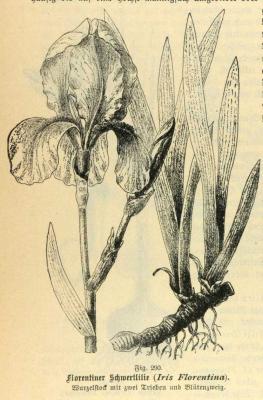
Picture modified from Gilg, Ernst; Schumann, Karl - Das Pflanzenreich Hausschatz des Wissens (1900) - Permission granted to use under GFDL by Kurt Stueber. Source: www.biolib.de - Permission is granted to copy, distribute and/or modify this image under the terms of the GNU Free Documentation License, Version 1.3 or any later version published by the Free Software Foundation; with no Invariant Sections, no Front-Cover Texts, and no Back-Cover Texts. A copy of the license is included in the section entitled GNU Free Documentation License.
More to follow.
Tuesday, April 02, 2013
What's Blooming?


 Sweet Cherry.
Iris bucharica.
Muscari. These multiply rapidly with no assistance from me.
Genetic dwarf peaches..
Monday, April 01, 2013
Laburnum Cutting
 Laburnum grown from cutting the same way as figs. Looking pretty good. I potted them a few weeks ago.
I'm happy to have Spring here now, and the cuttings growing. I'm recuperating and can't do much for a month or two. Fortunately, watering cuttings and minor tasks are do-able and cheer me up.
Laburnum grown from cutting the same way as figs. Looking pretty good. I potted them a few weeks ago.
I'm happy to have Spring here now, and the cuttings growing. I'm recuperating and can't do much for a month or two. Fortunately, watering cuttings and minor tasks are do-able and cheer me up.
Back Yard
 By necessity the yard is in a state of benign neglect now. Fortunately I did a lot of pruning and clean up in previous weeks. Nice the fruit trees and bulbs are blooming.
 An antique narcissus variety. The bunches each started with 1 to 3 bulbs. Now I need to find the name again. They could stand to be dug up and divided this summer. Hard to see but there are also Juno Iris in the photo. The chive barrel is growing nicely. Maybe Ning will make chive dumplings in a week or two. Comfort food.
Sunday, March 24, 2013
Raised Beds. Kitchen garden and irises.
 Vegetable bed. I temporarily added a couple of irises, I didn't want in the one iris bed so far. Also some raspberries from home. If I can build another bed in a couple of months, they will move to that.
The black wooley-looking stuff is fur trimmed from Charlie. Purpose is to deter rabbits and deer. Might help. Might not. Bok Choy, chinese cabbage, radishes, turnips, spinach, have all sprouted.
 Allium vegetable bed. Looking great. We are getting lots of scallions. Garlic chives are growing the thickest and sturdiest I've ever seen them grow. They will be ready to harvest in 2 weeks.
I won't be posting for a week or two. Maybe something on fig cuttings tomorrow. Likely wont do much in the garden for a month or two. We will see. Having these progress reports to look at, will help.
Beehive. Feeders in place.
 Thebee feeders are in place. Ruhl-Bee states they will arrive first or 2nd week of April. I hope 2nd week. It may be difficult, earlier. Counting the days....
Charlie and Baigou
 Almost unrecognizable after haircut.
  They stay closer together after their haircuts. Warmer. Much more lively now without the heavy coats.
Tuesday, March 19, 2013
Kitchen Garden. Scallions
 Fantastic! The first vegetable from the raised beds at Battleground. These were Egyptian Walking Onions, planted Sept 27th. Not only did they survive the winter, they flourished.
Monday, March 18, 2013
Bearded Irises. Progress Report.
 Spring growth is sturdy. Stout leaves and firm rhizomes. No evidence for animal damage.All rhizomes took hold, survived the winter, and are growing.
These were last minute mail order. I had doubts they would survive the winter. Planted too late to take hold, too dried out. November I think. They are growing nicely.

Beekeeping. Progress Notes. Top Bar Hive

 I decided to paint the hive. Will last longer. Less likely to mold mildew rot. Used white primer and a white outdoor latex. Decided on a different location. This location is in full sun but also secluded, for safety. Near Ning's planned wildflower meadow. There is a sizable bramble patch behind, for near by nectar. I want to plant lemon balm around the hive.
Open, with some bars removed. Now it depends on when the bees arrive. Someone has offered to help in case I am indisposed, which I might be. Bad timing but it is what it is. Been so looking forward to this....
Sunday, March 17, 2013
Laburnum Cuttings
 Brought the cuttings home to pot in potting soil, and some mycorrhizal inoculant
 It's a delicate stage for them. New growth is all white - needs light to make chlorophyll. But not too bright - could burn. And could dry out. Interesting to see what happens.
Front Yard
 Rhubarb not quite ready for pie. Maybe 2 weeks.
 The pink tree is "Hollywood Plum". There may yet be some frosts / freezes, in which case maybe no plums. I always think about that, this time of year.
 Side/Front yard. Spring is here. I'm impressed with the amount of diversity in this small space.
Saturday, March 16, 2013
Hardwood Cuttings from Trees. Progress Report.
I'm starting to think this propagation method is very good. Not just for figs. Fig cuttings root easily by almost any method. These were prunings I had lying around this winter. I did what I've been doing to jump start fig cuttings. Use cuttings about 6-8 inches long. As thick as practical - pencil thickness seems good. Thinner or thicker seems to work. Make incision through bark and cambium layer using sharp pocket or kitchen knife. Dip in rooting hormone dip-and-grow at 1:10 dilution 1 to 2 minutes. Wrap in moist paper towel. Place into plastic bag and close. Keep in warm place.
 These cuttings are from ornamental plum. They have calloused well. There is some top growth. Not sure if roots are developing yet. I think I see root initials. So these are still in the "maybe" category as to whether they will develop into little trees.

Laburnum (golden chain tree) cuttings. These are also a few weeks old. Same method. The top cutting is a "mallet" cutting. It is a small branch. The base is trimmed with some remaining stem from the 2-year growth, trimmed. The bottom cutting is similar, pruned just below the junction with the previous years' growth. The middle cutting is just new wood. All have calloused and are forming roots. Some previous years' growth seems to work best. Small sample size of course. With these, some previous years' cambium seems to help.

Redmond American Linden. These have some callous. They leaked a jelly-like sap for a while. Not much. The root initials look promising. They are also in the "maybe" category, as to whether I'll get trees from them. If the tops grow too fast, they might overwhelm the almost embryonic roots.
 These cuttings are from ornamental plum. They have calloused well. There is some top growth. Not sure if roots are developing yet. I think I see root initials. So these are still in the "maybe" category as to whether they will develop into little trees.
Laburnum (golden chain tree) cuttings. These are also a few weeks old. Same method. The top cutting is a "mallet" cutting. It is a small branch. The base is trimmed with some remaining stem from the 2-year growth, trimmed. The bottom cutting is similar, pruned just below the junction with the previous years' growth. The middle cutting is just new wood. All have calloused and are forming roots. Some previous years' growth seems to work best. Small sample size of course. With these, some previous years' cambium seems to help.

Redmond American Linden. These have some callous. They leaked a jelly-like sap for a while. Not much. The root initials look promising. They are also in the "maybe" category, as to whether I'll get trees from them. If the tops grow too fast, they might overwhelm the almost embryonic roots.
Wednesday, March 13, 2013
Ning with Tiller
 Here's Ning rototilling an area of lawn. If all goes by plan, this will be a wildflower meadow. There will still be grass in the meadow. THe tilling opens up sod to give the seeds a chance. We've never done this before so it will be interesting to see how it turns out.
Monday, March 04, 2013
Pear Grafts
 After taking the Home Orchard Society grafting class, I was anxious to try. These are the attempts. This is a russeted Asian pear, Chojuro. I've grafted a nonrusseted variety, unsure cultivar. Purpose is for pollination. Mostly I think it's just cool.
  This is the nonrusseted Asian pear. Unknown variety, had one pear last year. Grafted another unknown onto it from my home tree, plus 2 Euro pears, Orcas Island and Rescue. I tried to graft near the trunk. Not the best grafts I've seen. We did bench grafting in the class. Learned whip and tongue graft, which took more finesse than I have on the bench. On the tree it would likely have meant a blood sacrifice to the tree god. So I tried the less hazardous but possibly less successful cleft grafting. No loss if they don't take. Pears have a reputation for easy grafting, so maybe.
Sunday, March 03, 2013
New Plants. Anemones, Ixia,
 This is sold as "Pink Forsythia". It's not a forsythia. Some varieties are white, not pink. It's Abeliophyllum distichum 'Roseum'. The flowers are blooming now which is cool. The plant seems to have a forsythia-like shape, and pseudoforsthian flowers. The name is OK. These plants originate in Korea. I guess that's considered exotic. Forsythias all originate in China, Korea, and Japan. I'll try to take a better pic net time. The plant is not as fuzzy as my pic.
 Anemone coronaria De Caen. This pic from Amazon, although I bought them at Fred Meyer. These are new to me but not to horticulture. It's hard to find pics of the whole plant, so it's hard to predict what it will look like. From wikipedia, Anemones are called "poppy anemone, Spanish marigold, "dağ lalesi" in Turkish, "Calanit" in Hebrew, "Shaqa'iq An-Nu'man" in Arabic". Also from wikipedia, the Arabic name is thought to originate from "the Sumerian god of food and vegetation, Tammuz, whose Phoenician epithet was "Nea'man". Tammuz is generally considered to have been drawn into the Greek pantheon as "Adonis". Adonis died of his wounds while hunting wild boar... [Adonis] transformed into a flower, stained by the blood of Adonis. Tammuz's Phoenician epithet "Nea'man" is believed to be both the source of "An-Nu'man" in Arabic which came through Syriac, and of "Anemone" which came through Greek. They go on to say, "Another possible source of the name is An-Nu'man III Bin Al-Munthir, the last Lakhmid king of Al-Hirah (582-c.609 AD) and a Christian Arab. An-Nu'man is known to have protected the flowers during his reign. According to myth, the flower thrived on An-Nu'man's grave, paralleling the death and rebirth of Adonis. That last version seems unlikely. Whatever the history, they look interesting. The plants that survived the winter are growing nicely. The leaves are finely cut and ruffled, thick and green. Multiple web sites state all parts of the plant are toxic, and deer and rabbits leave them alone.
Also new to me, but not to horticulture, Ixia. This pic from bloomingbulb.com but I bought them at Fred Meyer. Most web sites state they cant handle cold wet conditions, but the row I planted last fall appears to have survived. The plants are about an inch tall. Again, it's difficult to find pics of the plants in bloom. Just the flowers. I became interested in these when I saw what I think were Ixia at a house we looked at and almost bought. The yard was full of them, hundreds. All one color, yellow. If they were Ixia, that variety seemed must do fine here. From ces.ncsu.edu IXIA Hybrids...Cream, purple, rose, yellow or yellow flowers)...very late spring (May/June)...~16 inches tall...Injured at temperatures below 28 degrees F (-2C) when planted...warm (75 to 80F) - cool (35 to 45F) - warm (50 to 65F) annual thermoperiodic cycle...Climatic zone habit: 1990 USDA Climatic Zones 6 ot 7 with mulch, Zones 8 to 9 without mulch...Full sunlight only. Some sites emphasize the need for dry season when dormant. Here, summers are dry but winter is wet. That the row I planted last fall survive is encouraging.
Irises. Progress Report.
 This is the iris clump, I uncovered and weeded to rejunenate. That was a few weeks ago. Southeast side of the house, raised area. Growing fast now. From the size, if grown from one rhizome, my guess is 15 or 20 years old. Soil must be depleted of nutrients. I might give it some organic fertilizer. But doing well for a supposedly malnourished colony. It should be dug up, divided, and replanted to rejuvenate. First, I want to see what the color is and what the appearance is.
 This is the iris raised bed. All rhizomes are now growing. That includes the one I was sure was dead, a variety called "Red Zinger" bought during the winter. It has a side shoot. I've been trying to get a Red Zinger growing for 5 years, but lost the last start. Literally, it may be in there somewhere but never bloomed. Which is odd because only some of the photos look good to me. Iris colors photograph strange, often not like the actual plant. So only if it blooms do I know if I want it. The winter-mailed rhizomes have also put on sturdy appearing growth. Anemones, planted as one edge for animal repellent (poisonous plants) are mostly growing well but it looks like I lost 4 or 5 to winter. Planted replacements today. I never grew anemones before.
Raised Beds. Progress report.
 Here are the raised beds now. I added another this weekend. Planted the new bed with Snow Peas Oregon Giant, Bok Choy, Spinach, Radishes, Lettuce, Onion sets, between the onion sets planted Evergreen Bunching Onion seeds - packaged for 2011, might not grow. Also Swiss Chard 5-color Silverbeet, Beets Detroit Red, and Chinese Cabbage, Napa variety. Most of the rows are short, 2 foot rows. The Snow Peas and onions are full 4 foot rows. Also a row of mixed color Ixia. For color.
 The allium raised beds, planted last fall. Growing by leaps and bounds. Amazing to this small town Illinois boy, a garden with rapidly growing plants before March first. Garlics are about 1 ft tall. Shallots about 6 inches, White Potato Onions about a foot, and Egyptian walking onions about 6 inches. Illinois Chinese chive is about 2 inches and Changchun Chinese Chive is about 1 inch but thicker and sturdier and growing faster now. The Chinese Chive seedlings from last fall have reappeared, I think, although those might be seeds I planted last month.
Tuesday, February 26, 2013
Planting Seeds. Planting Fruit Trees.
Planted these today.
 The Catnip and Lemon Balm are listed in companion planting books as beneficial to various vegetables. I don't know that I believe that, but no harm either. I could have just divided more of the volunteer lemon balm from the yard. Wanted to see if the seedlings are different. Somewhere I read, Malva zebrina is a Korean vegetable. Better find that before eating it. Seedaholic.com states they are edible and have a mild flavor. pfaf.org states the leaves can be used in salads and soups, and the flowers are an edible and tasty garnish. Planted in old plant 6-packs I had in the garage. Reuse / recycle. Once they are growing I can put them in the protected raised bed to acclimate.
Also planted the Orca pear and Rescue pear that I had buried in compost on Sunday. Glad they are in the ground.
 The Catnip and Lemon Balm are listed in companion planting books as beneficial to various vegetables. I don't know that I believe that, but no harm either. I could have just divided more of the volunteer lemon balm from the yard. Wanted to see if the seedlings are different. Somewhere I read, Malva zebrina is a Korean vegetable. Better find that before eating it. Seedaholic.com states they are edible and have a mild flavor. pfaf.org states the leaves can be used in salads and soups, and the flowers are an edible and tasty garnish. Planted in old plant 6-packs I had in the garage. Reuse / recycle. Once they are growing I can put them in the protected raised bed to acclimate.
Also planted the Orca pear and Rescue pear that I had buried in compost on Sunday. Glad they are in the ground.
Subscribe to:
Comments (Atom)