Sunday, May 15, 2022

Planting More Squash Seedlings. 5.15.22

 I planted more squash seedlings in their final locations.

This is a Galeux d'Eysines.  The roots quickly start winding around.  Squash seedlings roots are delicate, so you want to get them planted ASAP.


Fortunately they are very early in their winding around, so it just took slight untangling to point the roots outward.


Now planted outside:  All three Galeux, both Costata Romanesca, and one Fordhook zucchini.  Here is a Costata:


I will need to set up deer protection for the ones outside the fenced garden.

I also gave away a zucchini plant "Sure Thing", a summer squash plant "Saffron", and two Red Kuri squash seedlings.  Now remaining for me to plant are three seedlings of Burgess Buttercup, three of Uncle Dave's Dakota Dessert Squash, one Saffron summer squash, and two or three Honeynut.  Not sure where I'll plant them, but if Honeynut has small squashes, it might be a candidate for a trellis.

Saturday, May 14, 2022

Planting Squash Seedlings. 5.14.22

 So far, the squash seeds that are growing are, Costata Romanesca, Fordhook Zucchini, Galeux d'Eysines Pumpkin, Uncle Dave's Dakota Dessert (Buttercup type), Red Kuri, Burgess Buttercup.   I think there are signs of life with the Honeynut, Saffron, and Sure Thing Zucchini.  Two will be given away, and I need to plan where to plant the others so I don't confuse myself.

I decided the two buttercup types will replace the massive Pink Banana and Illinois Squashes this year.

I may plant the smaller bearing Honeynut Squash against a trellis, for space conservation.


Squashes grow fast.  I need to get them into the ground within a week.  Here is the first of the Galeux d'Eysines, which was all I could plant before rains resumed.


Irrigation for Tomatoes,1 gal/hr Emitters. 5.14.22

 I set up the irrigation system for the fresh tomato raised bed.  First, I arranged the lines on top of the kraft paper mulch, so I can see if they work.  The 1/4 inch lines are re-used from last year.  I used new emitters because of concern they could clog from a season build-up of minerals.  Plus, some broke when I took apart the lines to build the beds.


Here is a video showing the flow.


Thinking about how much to use.  When I use the watering can, one full can is two gallons.  I use roughly one full can for four plants, at a time.  Depends on how hot and how big they are.  That's about 1/2 gal per plant.  That would mean let the system run for 30 minutes for a similar amount.  The paper mulch will reduce evaporation and soil drying, so I may get away with watering less often.  I can always check soil moisture.

After the test run, I shifted the emitters to be under the paper.  Now the irrigation system is completed for this bed.

I still need to add paper mulch for the onion bed, then plant sauce tomatoes and install emitters and mulch for that bed.  In a couple more weeks, I'll do the same for the chili pepper bed.  Also, I'll install a branch for squashes which will be in ground.  Last year I watered them by hand, which was a major effort.

It seems like a lot, but the advantages are significant.  First, with about 20 tomato plants, at least 1/2 gallon per session, that's about 5 trips with the full watering can per day or every other day.  I think it's actually more.  For the onions and garlic, or beans when those are done, it's another approx 4 trips per bed, and 4 more for the large planter box.  So that's roughly 25 watering can trips per watering session.  Or the hose, which is a lot of difficult lugging the hose around and standing out in the heat (or smoke, if we get a bad fire season.  Hope not.).   It's also a major water savings over using a sprinkler system.

Thursday, May 12, 2022

Potato Bread. 5.12.2022

Today I made bread using a mixer with dough hooks, for the first time.  Part of my drive down the nostalgia highway.  I used the recipe in the old Mixmaster cookbook.  The recipe was for potato bread - Mashed potatoes, water, egg, flour, a little sugar, a little salt.  The mashed potatoes were made with potato flakes, water, milk, butter.

It was very nice using the mixer to knead the dough.   I mistakenly left out the egg and sugar until after kneading, so added them and kneaded a bit longer, adding a little more flour.  Not as easy as if I included them before kneading but the loaf still came out great.


The loaf was delicious!  It had a great rich flavor, nice crust, slightly chewy texture.  Nice old fashioned home made bread.  

I never wanted to use dough hooks - sort of takes the baker a bit away from the dough.  But, I thought the process was kind of empowering.  Kneading by hand is too much work now.  Cleanup was easier too.

I could easily see going another step further, and making the mashed potatoes from home grown spuds from the June harvest.

Making Garden Mineral Supplement Using Chicken Bone & Wood Ash. 5.12.22

 In addition to eggshells, I make garden mineral supplement using wood ash and chicken bone.  I am vegetarian, and all of the bones come from the dog food I make for Rufus, which uses chicken thighs.   My calculations from the few articles that I could find about chicken bone ash, is that Calcium content is about 68% and phosphorus content is about 29%.  Wood ash is more complicated, varies by tree species and probably where it is grown.  From Wikipedia, calcium content can vary from 25% to 45%, less than 10% potassium, and less than 1%phosphorus, with the rest being trace minerals.  

By my tests, my garden soil is deficient in calcium, phosphorus, and potassium.  So I supplement.  Growing crops removes a lot of those elements, which go into the plants and the food products.

I dry the chicken bones same same as I do eggshells.  They are already slow cooked overnight in the process of cooking for Rufus' meals.  I haven't been using the woodstove much, but today was chilly so I made a fire and added a big batch of bones.


After the fire burns out and cools, I collect the ashes and spread on the garden soil.  It's a dusting, not a thick layer. I prefer doing that before planting anything in that area and letting it mellow a week or more.  In the past I tried just burying the bones, but sometimes they don't break down and I find them when  cultivating.  Burnt bones are mostly fine ash, and the ones that are recognizable are brittle and crunchy like potato chips, and disappear when cultivating.

Squash Seedlings. Home Saved Seeds Germinate Faster. 5.12.22

 Of the squash seeds that I planted, the home seeds are all showing germination.  That is Galeux, Fordhook, Red Kuri, and Costata.  None of the purchased seeds are up yet although some seem to be swelling a bit.

Galeux


I don't know why the home-saved seeds would germinate faster.  I've also noticed that with tomatoes.  To hazard a guess, maybe I let the fruits ripen completely on the vine before saving seeds, while sellers might use less fully ripe ones?  Or maybe their storage is different in some way.  Mine are dry, in paper envelopes, in cool pantry.

I think the bought ones should still germinate.  They just seems to take longer.  Last year, my own Pink Banana Squash germinated in a week, but new bought ones needed two or three weeks.

Making Eggshell Soil Supplement. 5.12.22

 My soil test indicated low soil calcium.  Lime is a perfectly good calcium supplement, as is good wood ash.  So is ground eggshell.

I dry the eggshells until ready to grind up.   I store them in an open container so they dry quickly and done become gross.  I used to crush them in my hands but the food processor does a better job.  I don't know if they will dull the blade over time.  I have t noticed any issues.


I scatter the ground eggshell and, when the soil is cultivated, it disappears into the soil.  The main mineral in eggshell is calcium and a fair amount of phosphorus, but they also contain small to trace amounts of  magnesium, sodium, aluminum, boron, copper, manganese, iron, potassium, sulfur, and zinc.   Eggshells are 5% protein, so there is a fair amount of nitrogen as well.  Research varies as to the pH altering effects..  I think that is due to, the eggshells are slower release than lime so the effect is spread out over a longer time.

Considering the high cost of things, it seems like it's a good idea to make use of the eggshells' nutritional benefits rather than disposing of them in landfill where they serve no purpose.  Combined with coffee grounds and bone ash, this is a replacement for much of the fertilizer needs of my vegetable garden.


Wednesday, May 11, 2022

Rufus Had A Spa Day. 5.11.22

 Rufus has been panting more, which I take for being too warm.  So I gave him a haircut and a bath.


He KNOWS what's about to happen.  Even though he really doesn't like the face and paw parts, he jumps onto the table anyway.  I use mix of scissors and clippers depending on how sensitive an area is and how evenly I want it cut.  Then he gets a good bath, which he likes a lot.

After.  There's that handsome boy!


Not as nice a cut as a professional groomer, but a lot less stress for him and for me.

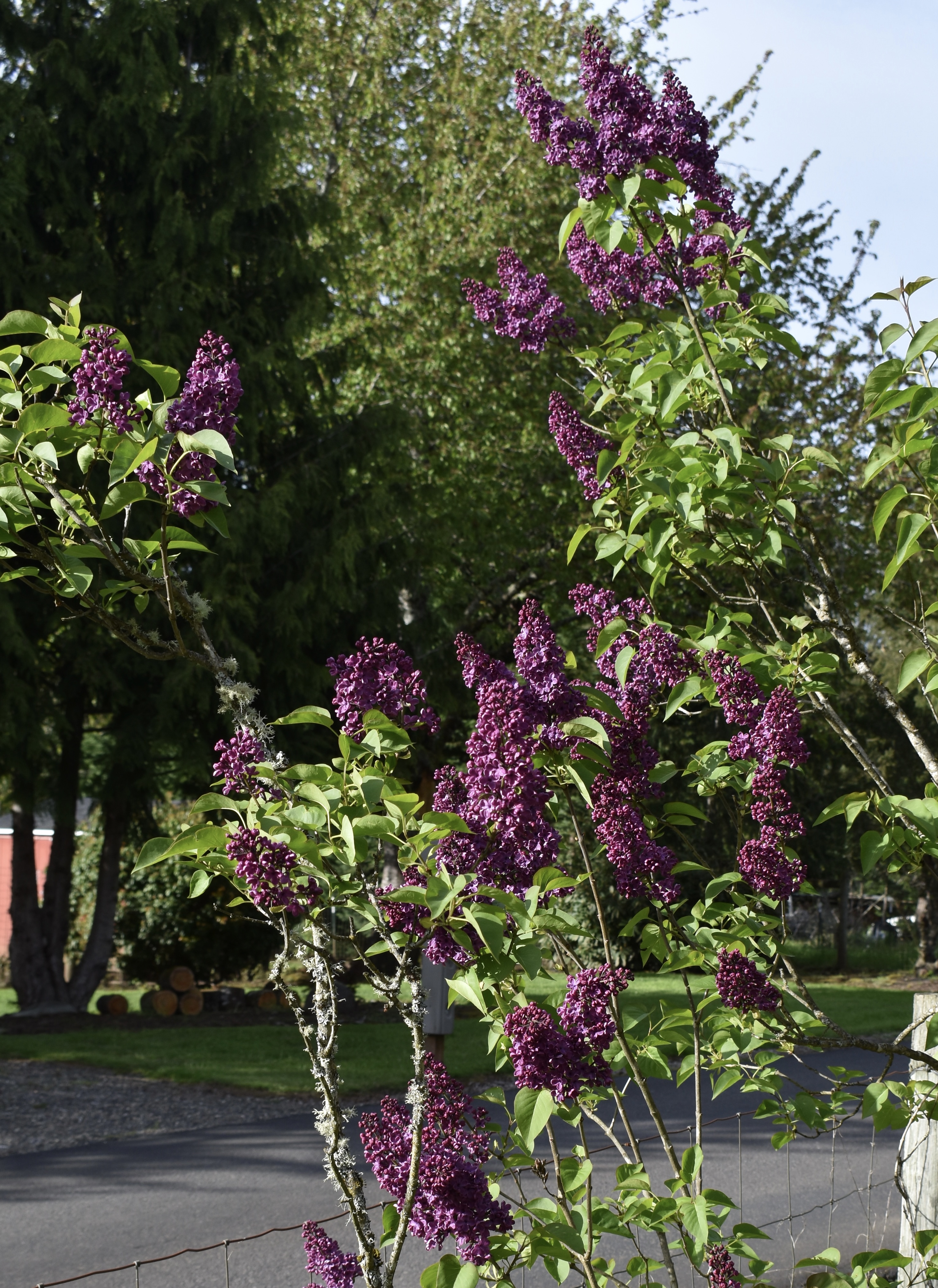
Lilacs, Again. 5.11.22

 I can't believe how big these lilacs grew.  Of course, they are at least fifteen years old.  They survived a big move from the Vancouver house the the Battleground house, about six years ago.  That set them back but they are doing better now.


Installing Drip Irrigation For Raised Beds And Container Planter. 5.12.2022

 Today I completed the drip irrigation installation for the new container planter.  Since there are ten nearly round, 25 gallon containers, I made round loops from 1/4 inch tubing which had four emitters.  The ones for the potatoes had 7 emitters, because they will need to soak more deeply.


I might add a length with another emitter or two depending on my observations but this seems good so far.

For the tomato (Johnson Dwarf Cherry), I also covered with kraft paper to reduce fungal disease risk.  The paper covers the emitters.

The drips work nicely.  Over about an hour, the contents of the containers are fully watered.


Then I checked the soaker hoses for the garlic bed.  They worked fine, so I put them under the kraft paper mulch.  I can't believe how big the garlic plants have grown.  The variety is "Music", and I grow them from the biggest bulbs from the previous year's crop.  


Then I checked the soaker hoses for the onion bed.  They work fine.  I cultivated between rows and intend to lay a kraft paper mulch soon.

So that's drip irrigation installed for three of the six raised beds, and the main lines in for the remaining three.  Almost ready for summer.

Edit:  Here is what the drip irrigation system looks like for the container planter.


Monday, May 09, 2022

Lilacs. 5.9.22

 Despite losing some lilac  blossom clusters to late frost, there is a nice show.


First Tree Peony. 5.9.22

 This is the first tree peony of the year.  I don't know the variety name. 


Figs Update. 5.9.22.

 Here are the figs on the "Brunswick" fig tree.  It looks promising.  


This tree likes to make a lot of promising looking baby figs, then most if not all of them fall off before they ripen.   However, when they do ripen, they are the biggest, sweetest fig that grow.

Edit:  Most of the other fig trees are at a similar stage now.


Potatoes' Progress. 5.9.22

With so much rain and not-bone-chilling weather (not warm, just cool and perfect for potato plants), the potato plants are growing like gangbusters.

The first rows, sprouted grocery spuds, needed to have their trenches filled in.  I'm behind on that due to back problems, but getting better.  I tried to be ergonomic, not put my back into it, and fill in the major parts where the plants were largest.  Those were planted Feb 13.  I think.  So this is three months of growing, but the first part of that quite cold.


The ones I bought as official seed potatoes in March, and planted March 12, are growing equally well.  I had dug trenches about a foot  deep, piling the soil between the rows.  Now I'm filling those embankments back into the trenches around the potato plants.  Between my physical limitations and the rains, weeds grew like weeds (LOL).  Most of those get sort of incidentally removed as I relocate the soil back into the trenches around the potato plants.  It's not "Martha Stewart" classy, but then I'm more Betty Crocker than Martha Stewart, anyway.  Or Fred Flintstone, who is much younger than me.

Then I fed these plants with some soluble tomato fertilizer.  I prefer organic but we cant always be perfect about these things.  Potatoes are heavy feeders when young, and we want them to grow strong and produce generously.

Meanwhile, almost all of the other potato starts are emerging from the ground.  The most recent rows, from mid April, show new plants here and there.

Here are the first red potatoes (sprouted grocery spuds) that I planted in the big container planter on April 6.   So in less than a month, we have robust, healthy looking plants.  I had mixed organic tomato fertilizer with the soil, per label instructions.  They are not ready to fill in soil around the plants yet.  Soon.


Here are the Envol, super early variety from Fedco in Maine, which I planted roughly April 10, same method.


Things can change, but so far it looks like it will be a good potato year.  With higher food prices, that seems like a good thing.

Meditation Garden. 5.9.22

 Here are some photos of the meditation garden, also called the deer park garden because deer cone through here.  zit's sort of the blue season there, mostly Camassia and a few Hiacinthoides.


In addition to the fig trees that were already there, off the top of my head here are some of the established plants that I moved there over the past few months -

About a dozen big Camassia clumps.

Several clumps of Hyacinthoides

2 clumps of Crocosmia "Lucifer"

Several divisions of Horseradish.

4 divisions of rhubarb.

A half dozen large rosemary plants, but I think only 2 or 3 are surviving.

About a dozen sage plants.

About a dozen lavender bushes

Three Itoh peonies

Three clumps of Leucojum (large snowdrops).

About 5 daylilies (Transplanted two today).

Several divisions of lamb's ears.

A big helleborus.

A dozen sedums.

About a dozen forsythias that I started, closer to the fence, eventually for more privacy.

I'm sure I've forgotten some things.

Of new perennial starts from seeds, I've planted several six packs of Rudbeckias, two six packs of Coreopsis, a six pack of Gallardia, A six pack of Ratibida, six packs of common milkweed, tropical milkweed, four O'Clocks, echinacea, carnations, and some statice (I think the statice will be annual, maybe the carnations too).   I'm sure I've forgotten some things there too.

This summer I'd like to dig up some batches of spring bulbs that are abandoned around the yard, and plant those too.

I still have some room for summer annuals, which will be zinnias, lots of  marigolds, cosmos, cleome.  I out up the beginning of a privacy trellis for Morning Glories, which I already planted and growing, and sweetpeas which are already growing.

The common themes for everything, are drought tolerance, not appetizing to deer, adapted to this climate, and something to attract lots of bees and other pollinators.  I already know the established plants that I moved fit those criteria, because they are from this yard and grow happily here already.  if deer do eat something, I wont mind and I wont add to my efforts to protect it.  As for watering, I might do some minimally to get things established, but all of the established plants already proved themselves during the past dry seasons anyway.

Carnation Update. 2.9.22

 Like statice, I've never grown carnations before.  (Actually I might have but I don't remember and it wasn't here).  After losing the first batch, I didn't know if it was the timing, the pitting soil, or the cool weather.  So I planted a few more six packs of seeds.  I think the ones that did the best were the ones I planted in the larger silicone six-packs, but all did OK.

On April 8, I planted the first batch in one of the large containers in the container planter I built.  I kept the others indoors at night, outdoors during the day, until recently.  Here is how the first ones look today.

The irrigation lines should be hooked up in a week or two.    I think these are growing pretty nicely.  Last week I planted the second batch in another container, but outside the deer fence as a test.  Plus I didn't know where else to put it.  I also planted a couple in the ground in the meditation garden.  Today, I planted the rest of them in the ground there too.

I hope the early planting will give some nice flowers.  I read somewhere that deer wont eat them.  I don't know if the need a lot of water.  I think they might be fairly dry tolerant.  It's fun trying these plants that I haven't grown before.


Statice Status Report 😀. 5.9.22

 The statice plants that I set out in the large container bed on April 8, are looking pretty good.    Not growing by leaps and bounds, but they are growing and looking sturdy.  The red color had at first is more green-ish now.  The tubing is for irrigation lines I will install soon.


 The statice seedlings that I held back from planting outdoors in April, because I didn't know if it was too early, are a little smaller and the leaves have a more red - ish tint.  Kind of maroon, sort of.  They have been sitting in the vegetable bed for a week or two, pending being planted.  I planted them outdoors today.


  It's interesting, they look a lot like dandelions or similar weeds.  Also, they have a red taproot.


These are interesting plants.  I bet that taproot will give them good drought tolerance.   It's a good thing I didn't wait longer to plant them.   I planted four in a large container, and three in the ground in the meditation garden.  

Getting Dahlias Started Again. 5.9.22

 Last fall I dug up the dahlia tubers, pruned off the tops, let them dry out, and stored in boxes of peat moss over the winter, in the unheated, attached garage.  I gave the boxes of peat moss a little water during the winter but not much.  Maybe once or twice.

Today I got them out.  The actually look pretty good, and are starting to sprout.


I used a pruning saw to split a couple of them in half.  It's hard to have any finesse about it, because the tubers are all packed in there together.


Then I planted three of them.  My neighbor says that deer don't eat hers.  I don't know.  I planted the first three in  the blackberry enclosure, which has the room.  I might plant others in the open as a test,