Monday, April 10, 2023

Verbascum, Stocks, Dusty Miller, Echinacea, Rudbeckia Seedlings. 4.10.22

 I separated the verbascum, stocks, and dusty miller seedlings into their own cells.


The stratified Echinacea and Rudbeckia seedlings germinated rapidly.  Based on my starts in January, the Echinacea didn't need stratifying.  It didn't hurt, either.

This old LED distorts the image color.  The newer ones don't do that.


Starting Potatoes. 4.10.23

 The potato starts came from Fedco.  I bought early, mid season, and late varieties.  Envol, Red Norland, Kennebeck, and Elba.

I thought the brown discoloration inside one was concerning, so I wrapped it up and threw it into the trash.


The others looked OK.  Before cutting the others, I sterilized the knife by washing in hot water and soap, and then en with denatured alcohol.  I also changed to a new cutting board.


There were some small, sprouting Kennebec potatoes in the garage.  I planted the best looking ones 2 days ago.


Last year I planted too many potatoes.  It was a challenge digging them, especially with the heat and wildfire smoke.  I'm planting about half as many this year.

Eggplant Seedlings. 4.10.22

 Here are most of the eggplant seedlings.  Many of the old plastic pots are degrading, brittle, cracking and broken.  I bought these new ones.  I hope they will last longer.  Thicker plastic.  After use and hand wash, they go through a dishwasher cycle to sterilize.  I haven't tried that yet for these new ones.


I started these seeds in January.  They were slow at first because the sunroom wasn't warm enough.  They should grow faster now.

The varieties were from old seed packets.

Black Beauty (heirloom)

Black Shine (Japanese hybrid)

Nagasaki (Japanese heirloom)

Tomato Seedlings. 4.10.22

 I started the tomato seeds about March 15, I think.  I have been up-potting them into individual cells of the silicone 6-packs over the past 2 weeks.  This is about 2/3 of the plants.  The 


The green packs were up-potted a week ago, the blue packs were up-potted yesterday.  Growth has been much faster since repotting (green packs) compared to the ones I just did (blue).  The delay is OK, it's still very early.

Some went into taller containers, if the stem had stretched taller.  That was mostly the romas that were in the window instead of under LEDs.

As for varieties, Most are dwarf types or determinates.

From my saved seeds:

Dwarf Extreme Bush (heirloom) (red, small)

Livingston Dwarf Stone (heirloom) (red, medium)

Dwarf BrandyFred (open pollinated, dwarf tomato project) (brown/purple, very large fruit)

Dwarf Golden Champion (heirloom) (golden, large fruit)

Dward Tanunda Red. (open pollinated, dwarf tomato project) (red, very large fruit)

Dwarf Champion Improved. (heirloom) (pink, medium fruit)

Roma VF (heirloom) (sauce tomato)

Reisentraube.  (heirloom, not dwarf but seems fairly compact) I thought the Reisentraube looked too vigorous, compared to last year.  In case it was mis-labeled, I re-sowed those seeds last week.

From newly purchased seeds:

Sakura (Cherry hybrid, red)

Puck (open pollinated, very small plant)

Supremo (determinant, red sauce type hybrid)

Dwarf Moliagul Moon (open pollinated, dwarf tomato project) (light yellow)

Dwarf Eagle Smiley. (open pollinated, dwarf tomato project) (red, cherry)

Honeybee (hybrid, semideterminant, from an old seed pack) (yellow cherry)


Sunday, April 09, 2023

Overwintering Peppers. Update. 4.9.23

 Some of the overwintered pepper plants are looking very nice.  Aphids continue to be an issue,  I spray them off at least twicexdaily with water, containing 1/4 tsp miracle gro in 2 quarts of water.  That knocks of the aphids, and seems to boost growth both health and rate.   Thecheating mats are off now.  The sunroom is warmer too.

Jalapeño.   One blossom has opened, and there are lots of buds.  I should probably remove the flower buds.


The Tabasco pepper plants are both growing great!


The Serrano pepper plant is recovering.  The main challenge is keeping aphids in check.


I use a water spray, containing 1/4 tsp miracle gro in 2 quarts of water, to dislodge aphids and provide more nutrition to the plants.  That seems to help growth, and the leaves are darker green.

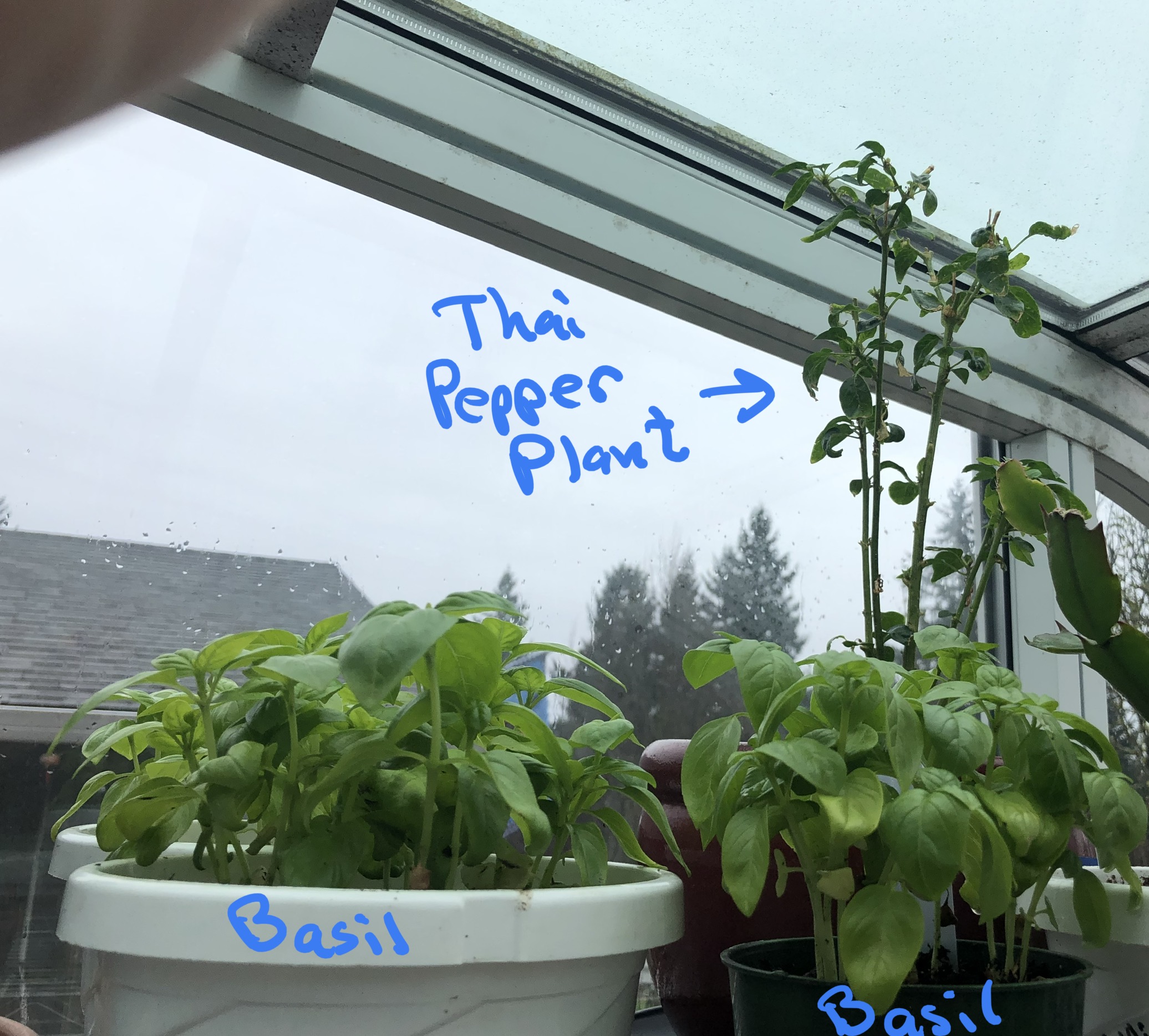
One Thai pepper plant died.  The other is on the top sunroom shelf, close to the sky window, because it doesn't fit under the LEDs.


The Cayenne is struggling.  The buds seem to grow, then stall.  It's alive, so I continue to take care of it.  It is also on the top shelf.


Sunday, March 26, 2023

Overwintering Pepper Plants. 3.26.23

 Here are the three best looking ones.

Jalapeño


Tabascos.


The biggest challenge now is aphids.  Unfortunately, the sprays are toxic to new growth.  That may have killed this Cayenne pepper plant.   It might still survive, I don't know.


This Serrano is even sadder.

As is this Thai pepper.


The only thing that seems safe for the plants, for removing aphids, is water spray.  I did add foliar-feeding strength fertilizer to the spray, 1/8 tsp per quart.  That doesn't seem to hurt the plants and might givevthem a boost, I don't know.  It also seems OK for seedlings.   I'll continue trying.

Red Star Quilt. 3.26.23

 I bought fabric for backing, but it had a cream color that I did not detect in the internet image.  I don't think that goes with the colors in this quilt.  Also, my bag of fabric scraps is too big, so I used a majot part of it to make this quilt backing.


The squares ate big, to reduce the number of places where the needle has to go through multiple layers when I'm quilting it.  This view is the back side, to show the seams.

Then I layered the backing with batting and the quilt top, and safety pinned it together.


I don't like the basting spray, the solvent is so strong, it smells like an auto body repair shop and it doesn't work that well for me anyway.


I like this quilt pattern enough that I decided to do a second take on it, this time with deeply intense batik fabric and cream colored backgrounds.  Here is the start of that idea.  It will take a few months to make, but easier than using upcycled shirt fabrics.  A lot of the pieces are from precut jelly rolls, and some from extra blocks from a prior batik quilt, or some fabric in my fabric bin.  The diamonds are 2.5 inches on a side, which is also the width of the jelly roll strips.   The squares that become hald square triangles are also 2.5 inches.  So the only parts that can't cone from jelly rolls, are the big background triangles.


Planting Potatoes. Bag Method. 3.26.22

 There were still some small potatoes, sprouting, in the garage.  Left over from last year.  They are a mix of varieties.  I tried to sort them out, so each group is possibly one variety.  The container method worked well last year, and potatoes were the only thing that did well in this planter soil.  So, excluding the soil that was used for potatoes last year, that's what I'm using.

I mixed 1/4 cup organic vegetable fertilizer into the surface soil of each container.


Thursday, March 16, 2023

Red Star Quilt, So Far. 3.16.22

 Haven't been posting much.  Will need to work on that.

Meanwhile, here is the red star quilt, so far.


I have mixed thoughts about this one.  I like the general concept very much.  It was a challenge, finding thrift store shirts that were right for making a quilt like this.  Then again, buying new fabric, I don't always find what I want either.  I like the idea of up-cycling fabric, when I can.  But there are limitations with that, especially colors and patterns.

Much of the sides and corners, is my own design.  The original pattern had large sections that were one fabric, except the red stars. I made it much more pieced together and added the grey half-stars as well.

I'm curious about how the same pattern would work, with rainbow or other color combination in batiks.  After so much sort of monochrome, I want to use some brilliant, saturated colors in the next quilt(s).

Meanwhile, I'm working on the backing.  I want to use up as much of the left over fabric stash as I can, so I'm not using a purpose-bought fabric for backing.  As a backing, it can be pretty plain.  I'm using the grey and white fabrics, cut into 9 inch squares.  There weren't enough big pieces, so I cut some into triangles.  Here is part of the backing.  It should go together fairly quickly now.


Monday, February 13, 2023

Red Star Quilt. Update. 2.13.23

 So far, so good.  The pattern is starting to emerge from the small pieces of fabric.

I made more than 220 2 1/2 inch square half square triangles, then kept in sandwich bags to keep track of which was which.  Each bag contained 8 each of the red triangle with one of three white or grey pattern fabric triangles.  Then I sewed them into strips of various configurations, for the sides of triangles that make the big star.  I also cut the diamonds, which become points of 8-point diamond stars.  For the Condor theme Nazca line them print, I tried to place a condor in the center of each diamond.


The original pattern has some fairly large expanses of un-pieced fabric.  I'd like for my quilt to have a more pieced look on the sides, but not detract from the rich red shade stars.  I got out some shirt collars and cuffs that went into previous quilts.  The diamonds are two inches wide, about the same as the shirt collars.  I removed stitches from the seams, to give the diamonds a 1/4 inch seam allowance on each side, and ironed them flat.  This was just BARELY enough, but I think they will look nice, when assembled.


I did the same with some shirt cuffs.  Same idea, but they are a bit easier.  This is all that remains from those shirts, after using the fabric in various quilt projects.  The cuff had a fused interfacing on one side, which I did not want.  Fortunately, the collar interfacing was not fused, and there were two cuffs, so enough fabric for four diamonds with no interfacing.


I think these will look nice on the quilt sides, breaking up the expanse of back ground fabric without detracting from the red stars.