Sunday, April 25, 2021

Potato Plants, Grown from Seeds or Planted Early from Saved Tubers. 4.25.2021

In about February, I planted sprouted potato tubers that I had stored in the garage.  These were mostly very small tubers, which is why they didn't get eaten.  They were mixed varieties, mostly a yellow flesh, a russet, and I'm not sure.  There were some frosts after that, and I did protect them by covering with a tarp, when that happened.


The plants are various sizes.  A couple did not grow, but most did.  Some are quite vigorous.  One feature of planting in trenches, is that moles sometimes dig across the trench wall, burying growing potato plants.  I don't recall seeing that before.  As they grow above the sides of the trenches, I'll fill the soil back into the trench.  That way, voles don't get at the growing potatoes, and they don't need much if any watering, and I don't have to haul soil in to hill them up.

Since I planted some more potatoes last week, which have not yet emerged, it will be interesting to see if these are earlier or larger, compared to potatoes that I planted much later.


Here are the Clancy "True Potato Seed" potato plants that I planted in trenches a few weeks ago.  There were also a couple of frosts, which I treated as with the other potatoes.  Also, a few buried by moles, but not many.  I uncovered a couple.  These still have the fencing in place, that I used so the tarp would not smash the little plants.  These are actually almost as big as the potatoes from old tubers that I planted weeks earlier.  Bigger than some.  Some are smaller - there is a lot of variability.


Notching to Encourage Branch Growth. 4.25.2021

 Akane is an excellent apple with a good "Jonathan" flavor, bears well, every year.  Unfortunately, I had let my Akane apple tree grow taller than I wanted.  I could have cut back the top, allowing new, lower branches to grow.  That would have meant no crop this year.

So I cut notches at points below buds where I want new branches to grow.  In a year or two, I can cut the bigger branches as the new lower branches fill in.


Now I'm thinking I should notch above those additional buds, for more branching.  

I never did this before.  Looks like it works just fine.


Saturday, April 24, 2021

Sad Looking Tomatoes from Wall 'o' Water. 4.24.2021

 Well, that was a mistake. The water filled teepees to keep the tomatoes warm appear to have worked too well and cooked those plants.  &^%$#!!


A couple don't look too bad but that Lemon Boy looks fried. Oh well.  I have backup plants of several varieties.  Those can go into the ground in a week or two.


Drip Irrigation System. 4.24.2021

 I don't know what I'm doing, but that hasn't stopped me before.  Here is part of the drip irrigation system I've been installing.  So far, I have it in the raised beds and a couple of containers.  It seems to take about 6 hours to provide an inch of water, which I expect to need every few days during the summer.  I can turn it on in the late evening, and return in the early morning to turn it off.


This took a few days, not too bad.  Next is the tomato bed, then the mini fruit trees and finally, the sweet corn bed.

More Apple Blossoms. 4.24.2021

 I went around and photographed more of the apple blossoms.  Almost all of the apples, whether early, mid season, or late season, are blooming now.


And Redlove Era


Lilacs. 4.24.2021

 It's been raining, so some of the lilacs are droopy.  Some are very nice.  Most of these are about 20 years old.  We bought tiny lilacs at the Canby plant fair in the early 2000s, and move them to the country house about 8 years ago.  A couple of them are starts that I took from existing lilac bushes.  Those may have a more extensive history, but I don't know it.  I also planted a few more starts this Spring.


Quilting Update. 4.24.2021

 I have been working on the disappearing nine patch quilt that I started in late March.   Since that post, I starched and ironed the fabric for stiffening and stability.  I learned that makes the fabric easier to work with, and with more precision.  The I cut the chambray and the batik fat quarters into squares, 5 inches by 5 inches.  I also cut batik fabric that is slate on black, the same size.  I am thinking this quilt will need about 49 large squares, but I will re-count when I'm closer to sewing them together.  There is enough fabric for three 9-patch squares of each color or pattern.

Today I completed sewing together all of the strips of three's.  Those get made into 9-patches by combining three strips.  This can all be whatever pattern or colors are wanted, or completely random.  But I have a pattern in mind (see previous post, linked).  Currently, I have 1/3 of the nine-patches made, and the rest are strips of three.

When the rest of the nine patches are done, they get cut into quarters, a slice down the middle vertically and a slice across the middle horizontally.  Then I rearrange them to see what I like.

Meanwhile, here is the start of the men's shirt quilt.  I want a quilt for my office where Rufus can lie on the bed and the quilt can withstand more washings than usual.  The men's shirts are noticeably heavier, higher quality fabric.  I raided my closet for some, and found some at thrift stores.  Total cost about $15, whereas the same amount bought new at a fabric store would be several times that.  I like the look and feel of these.  Combining the shirts for the quilt blocks and one shirt for the border, this quilt uses 8 shirts with a lot left over for other projects.  

To process the shirts, I wash and dry hot to pre-shrink them, although they have probably been through that before.   They get heavy starch, the I press briefly.  I cut through the seams.  Then I cut the shapes that I want, in this case 5 inch by 10 inch rectangles.  Later, if I want something finer, I could cut them down to 5 inch squares as in the 9-patch quilt, or something different.  depending on the size and cut of the shirt, that's barely enough blocks for some shirts, and lots of extras for others.

This quilt will be sort of like a brick street or brick wall, in shades of blue, white, grey, slate.  It's a simpler pattern than I've been making, with more muted colors.  I've seen others with similar design on the internet, although have not found a pattern for them so am making my own.

I've been looking for fabric for the backing.  If I can't find anything I like, I may do something similar but different pattern, for a reversible quilt.

These will need a few months to complete.  I enjoy sewing them very much, but the time at the sewing machine can make my back too painful.  So I have to pace myself.

Wednesday, April 21, 2021

Apples in Bloom. 4.21.21

Going around the yard, I think most of the apple varieties are blooming now.  It's interesting - sometimes such a big deal is made about having the same bloom times for pollination.  Right now, only a few are not in full bloom.  Some flowers might not get pollinated.   Then again, thinning the set fruit is a pretty big chore, so that's probably a good thing.  

Finished blooming - only Dolgo Crabapple.

More or less full bloom:

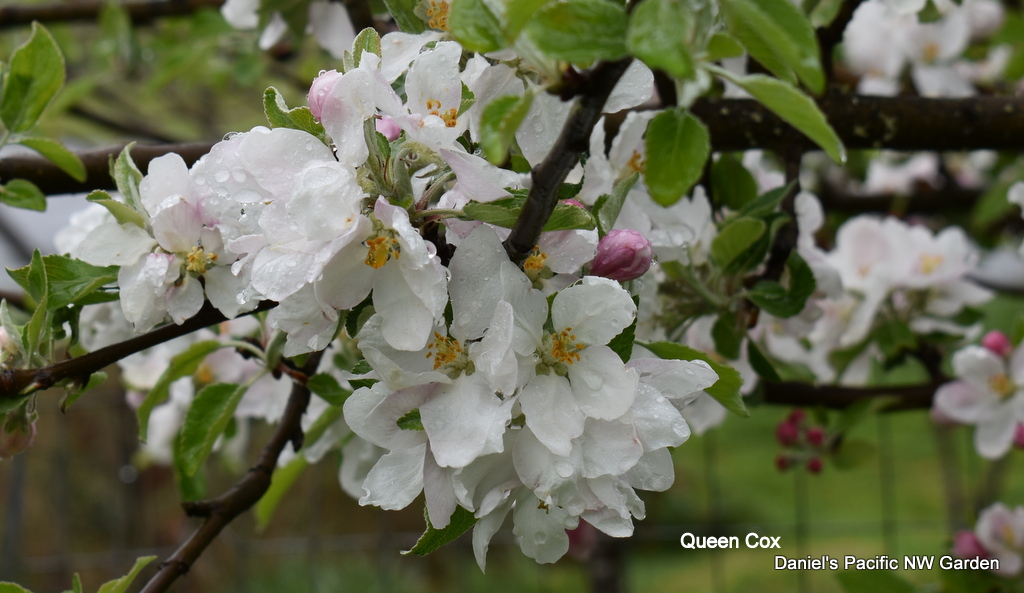
Gravenstein, Airlie Red Flesh, Rubinette, Northpole columnar, TastyRed Columnar, Golden Treat Columnar, Jonathan, Jonared, Priscilla, Prima, Queen Cox, King David, Jonagold, WineCrisp, Zestar, Sweet-16, Redlove Era, Akane, Sutton's Beauty, and probably some I've missed.


Sunday, April 18, 2021

First Apple Blossoms. Redlove Era and Urban Apple Tasty Red

 These are the earliest apple blossoms so far.  I have not checked down the hill.  Maybe there are some there too.

Urban Apple Tasty Red


Redlove Calypso.  Almost blooming.

Redlove Era.  These surprised me.


Irrigation System Project. 4.18.2021

 Here is the start of my new irrigation system.  There is still a lot of work to be done, and more parts to buy.

I buried the stretch of 1/2 inch tubing that goes from the tap to the garden.  It's easily depressable, and I don't want to trip over it or mow it, so it's buried in 3/4 inch vinyl pipe that was lying around for years.

Here is the splitter.  We still have access to the regular garden hose.  The irrigation system side also has an anti-siphen valve. 

This drone view shows most of the area I want to irrigate.  I think I need four separate lines, each with its own shut-off valve.  One for sweet corn area, and strawberries.  Corn requires a higher volume output.  One for miniature fruit trees, which I think I'll set up with soakers.  The tomatoes will also get soakers, I think, which is good to prevent soil borne diseases from contaminating the leaves.  The raised beds will get 1/4 inch drippers, which I think will be easier to judge the output.  It will all depend on how I feel about each arm of the system.  Maybe tomorrow or the next day, the section for raised beds will be completed and ready for testing.  There are various complications in each area, which I will work out as I go.