Wednesday, September 23, 2020

Baked Pasta Sauce. 9.23.2020

 My friend Rich gave me this recipe.  It turned out to be really, really good.  The recipe made use of sauce tomatoes, onion, garlic, and Jalapeños from my garden, which is something I liked about it.

Cut about 10 sauce tomatoes and layer on bottom of oiled casserole dish.

Add one big minced garlic clove.

Add 1/2 chopped medium onion.

Add 3 sliced Jalapeños.

Dust with salt and pepper and some pepper flakes.

Drizzle with 1/4 cup olive oil.

Repeat with another layer of sliced tomatoes, minced garlic, chopped onion, sliced Jalapeños, and the salt, pepper, pepper flakes and olive oil.

Bake at 350 without covering, 50 min.

Here's how it looked before baking.


Here's how it looked after baking.


Here's how it looked on some spaghetti.


There was about 1/2 remaining as a bonus amount (say bonus amount, not left over.  It really is a bonus).  I kept that in the fridge overnight.  Then I air-fried a summer squash, sliced into French fry size slices and some disks, dusted with season salt, garlic powder, pepper, drizzled with olive oil.  Air fried 9 minutes at 400, mix, air fry another 9 minutes at 400.  Then cover with the pasta sauce, which is heated in microwave for a couple minutes.

Here's how that looked.


 Both meals were delicious.  This is one of the best recipes I've made, ever.

Edit:  24 Sept 2020.  This sauce is also delicious on rice. 


New Raised Bed. 9.23.2020

 This is the first of three new raised beds that I have planned.  The old ones are in a location where I want to plant miniature fruit trees.  They are eight years old, and the untreated fir wood is rotting, especially the lower planks.  

This is part of my effort to build some gardening infrastructure for the future.  These beds are three planks tall - about 18 inches.  This height will be easier to garden as I age.  I will have the beds far enough apart, that I can have a walking assist device or bench between the beds.  Around the beds, I will have tree chip mulch.  The construction is surprisingly easy.  The corners are pre-cast concrete blocks with slots in the sides and a hole through the top.  The hole accommodates a rebar, which is pounded into the ground to hold them in place a little better.  The slots are made to fit a 2 x 8 plank.  I bought 8 foot long planks, the length of the bed.  For the width, I cut them in half, for 4 feet.  I bought treated lumber, and will line with plastic.

After leveling the ground, I lined three sides with plastic, and removed one end to roll the wheel barrow into the bed to dump garden soil.  When I get near completion, I will replace those planks and line the end with plastic before filling the end.

 The bottom is lined with a re-used layer of hardware cloth.  That wasn't big enough, so I added re-used chicken wire to make up the difference.  I folded the chicken wire to double it.  The purpose is to prevent tunneling animals from working their way up into the bed.


End removed to allow me to fill using a wheel barrow.  When I'm ready, I can just slide the boards back into the slots.

I wanted to re-use soil from previous raised bed.  That soil has received a lot of compost and some minerals over the years.  The dimension is also nominally 4 feet by 8 feet.  However, the concrete corner blocks actually increase the dimension.  Instead of losing 2 inches each war from butting the corners together, there is about a 2 inch gap in the block, so 4 inches are gained at each corner.  In addition, those old beds  had sunk into the soil over time, so the height isn't as much.  I bought a truckload of top soil. Combining the 1/2 yard of purchased topsoil with the existing soil from one bed, might fill that bed. 

When this is done, I'll plant garlic in this raised bed.  It's the only one that I am really motivated to complete before winter starts.  The others can be done during the winter.  My plan is, one for garlic, one for cucumbers, one for peppers.  There will be room for some other plants.  These are the main ones that benefit from raised beds in my garden.


Saturday, September 19, 2020

Redlove Era Apple. 9.19.2020

Today I harvested the first Redlove Era apple, and also a Redlove Calypso and a bunch of others.  This was the first apple from Era, which is in it's second summer now.  The Redlove Calypso has been in the ground less than a year.  It had three apples, and I ate one a month ago.

I forgot to upload a photo of the uncut apples.  I will do so if I can locate it.

For comparison, here are Airlie Red Flesh, Redlove Calypso, Liberty, and Redlove Era.  Liberty is a medium size apple, Airlie Red Flesh is small-ish.  The Calypso and Era apples were small, silver dollar size apples.


Era is much deeper red.  The skin is also more red, compared to Calypso.  Airlie usually has more red or pink compared to this apple.

The Airlie and Liberty were both sweet, apple-flavored apples with almost no sourness.  Calypso was very tart, and not much else.  Redlove Era was really delightful , a fruit or berry flavored apple, tart and sweet, sort of like cranapple.  

Fruit trees usually need a few years for their fruits to reach full size and flavor.  
it's nice to get this taste.  So far, my favorite is Redlove Era.

Slices from Redlove Era apple.  Very tasty.  The photo doesn't quite catch the true red color - a dark scarlet.


Corn (Maize). From Seikei Zusetsu, Japan, 1804

 Seikei Zusetsu is a book containing agricultural woodcuts from early 1804 and created in Japan in 1793 by unknown artists in Japan.  This image is from wikimedia commons.  I edited this image slightly, cropping for a narrower page border to emphasize the image better.  I find these images very compelling, combining some things I love to look at - Japanese art, 19th century book engravings (technically these were end of 18th century), botanical art, and history of agriculture and horticulture.  This is an image of corn, a crop originally developed in Mesoamerica (I guess millennia before Maya, let alone Aztec empires),  and spread around the rest of the world as part of the post-Columbian exchange.   I chose this image because now is corn harvesting time.


Friday, September 18, 2020

Bee forage, or not. 9.18.2020

 The wildfire smoke level is down to about 100, from well above 500 two days ago.  That's still not "clean" but not "hazardous to life" that it was.

I checked on the bees, through the window in their beehive.  I THINK they are OK.  Not much activity, today was cook and rainy so I think they wouldn't be going out anyway.  The yellow jacket traps have a few dozen yellow jackets - bad news, really. That means there are still lots of them out there.

Since it's cool and there are no bees out there, it may not matter now to have nectar and pollen plants.  But there might be sunny days now and then.

This is the patch of wildflowers that I planted in July, I think.  It was after the irises that were in this spot finished blooming, and I moved them elsewhere.  They are blooming nicely now.  I was surprised that they did this well, planting the seeds so late and watering only a few times when first planted, and a few times this month.  I don't know the source of the wildflower mix.  There are lots of bachelor's buttons, some coreopsis, cosmos, and a few zinnias.  That is most of it.  Deer have not eaten any of it.


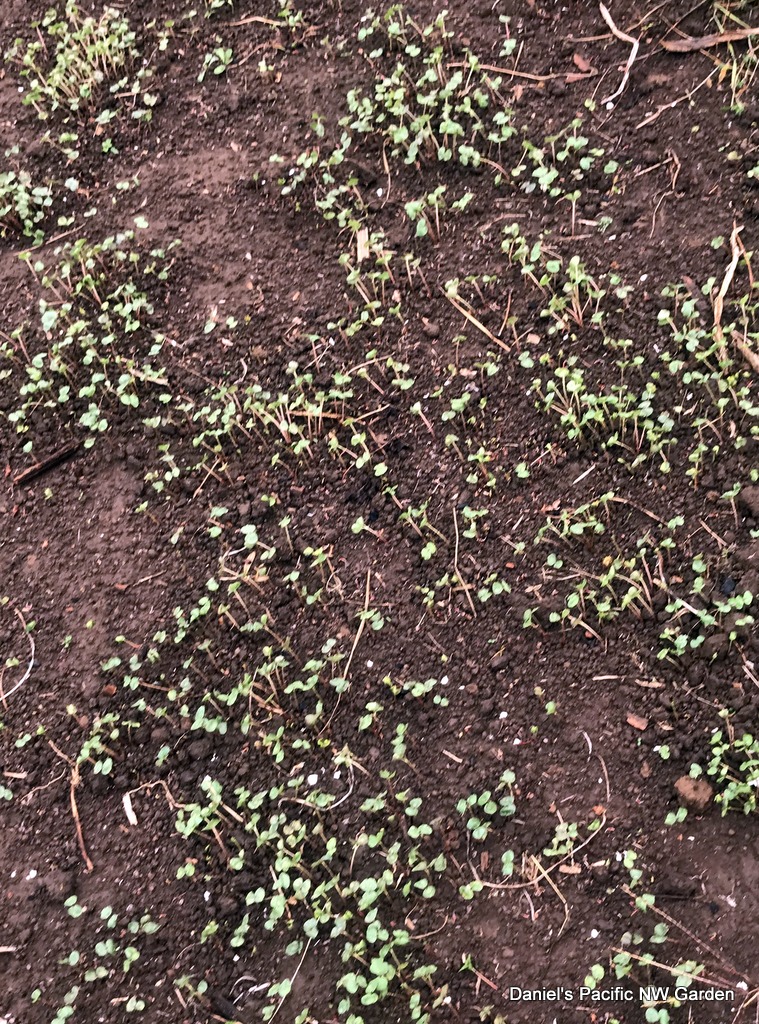
These are the buckwheat that I planted in the former potato patch, roughly two weeks ago.  I think they benefited from the smoke emergency, because the soil did not dry out so fast.  I don't know if these will just be a ground cover / "green manure" cover crop, or if they will bloom before the first frost.

These are the other buckwheat, planted in mid summer.  They are blooming very well.  It's not a big enough patch to sustain a hive, but it's not nothing.  This is a learning process for me.


Phacelia is not blooming yet.  I think it might be close.