Sunday, March 31, 2024

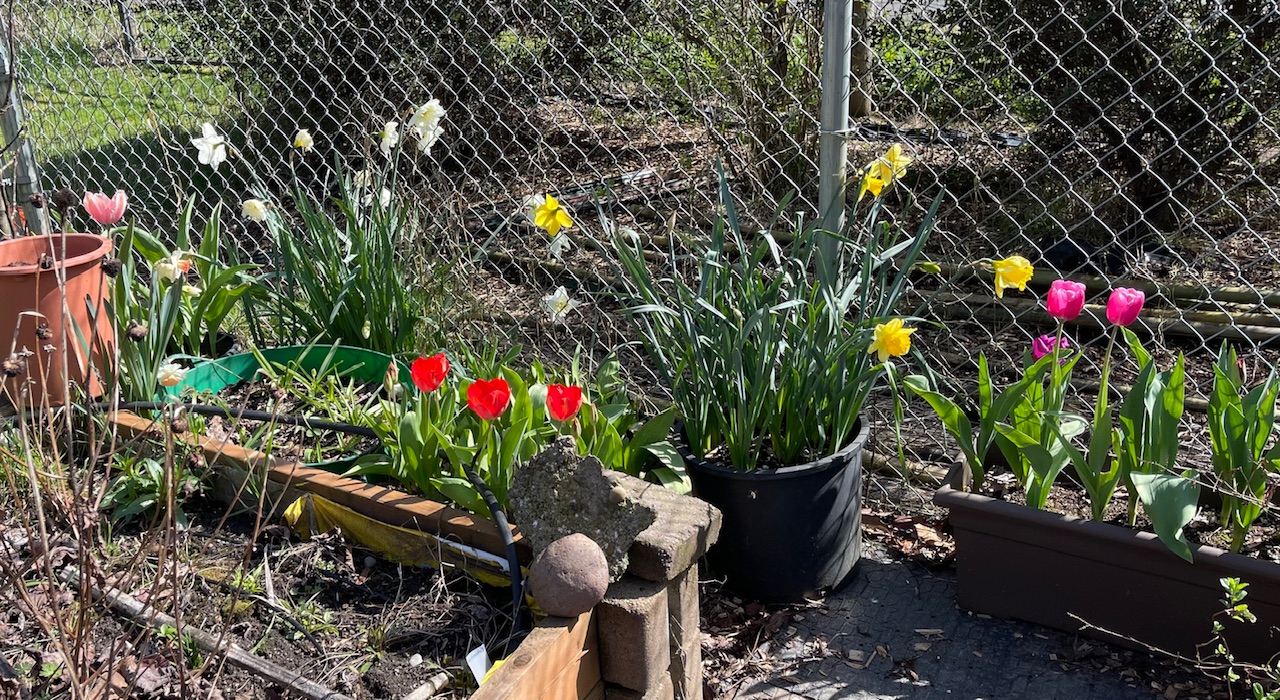
Flowers in Vegetable Garden. Bulbs and Climbing Roses. 31 Mar 24.

 These are all in containers.  They overwintered in place.


The big bunch of red tulips have been there a couple of years.  They get no care at all, beyond weed removal and some mulch.  And removing dead tops in Summer.  The container height works for accessibility.  It's the same size as a half whiskey barrel.

The other red tulips share a container with strawberry plants.  The only care they get is for the strawberries.  Those started to bear last year.  We'll see this year.

Yesterday I tied up the climbing roses that flank the gate.  Originally, I was going to build or buy a trellis, and have them meet over the gate.  So far I have not done that.

This variety is Tropical Lightening.  It's a beautiful rose and strong scent.  Growth is vigorous.  This will be its second year.  For the time being, I've tied it to a tall post.


This is a red climbing rose.  I grew it from a cutting, I think 3 years ago.  I don't know the name.  There was one flower last year.  With so much growth, I bet there will be a lot this year.  I tied it vertically to the espalier trellis post, to prevent sprawling and drooping. It must be over ten feet tall now.


I also pruned skinny or non vigorous looking growth from both rose plants.  

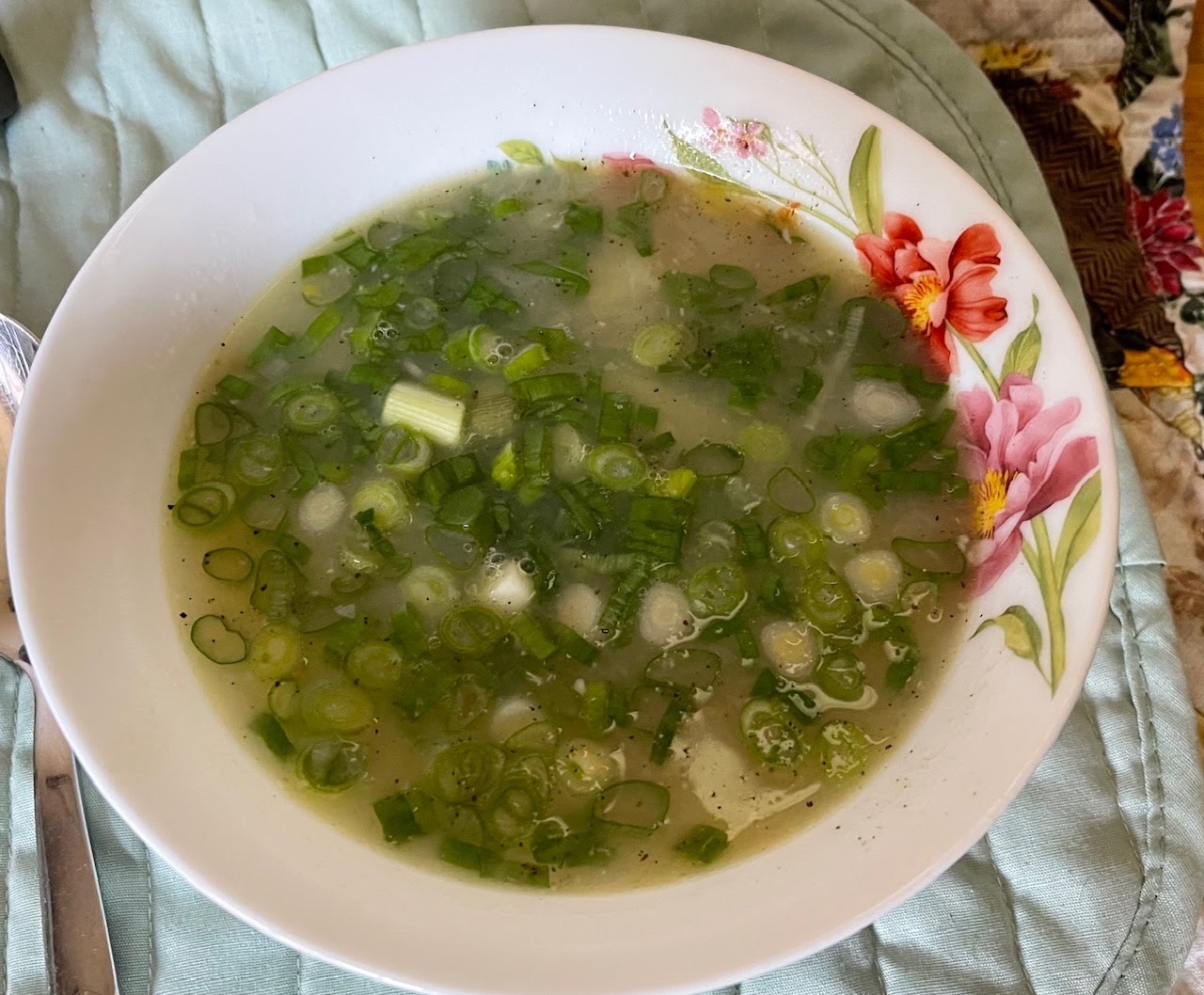
Potato Soup With Egyptian Walking Onion Scallions. 31 Mar 24.

 Potato soup gets eaten a lot here.  The Egyptian Walking Onions are a nice addition from the garden.


I don't use an actual recipe.  My mother made this often.  It's simple.   About 2 cups of peeled, sliced red, white, or yellow potatoes.  One medium onion, diced.  One tbsp margarine.  Two big cloves of garlic, crushed.  One teaspoon onion powder.   One tsp salt.   1/2 cup of milk.  Enough water to cover and then an inch deeper.  Finely chopped scallion, one per bowl.  Pepper.

I sauté the onion in the margarine until clear, in a large pan.  Add about a cup of water, the potatoes, salt, milk, garlic, onion powder, then enough water to cover about an inch above the potatoes.  Bring to boil.  Simmer 15 minutes.

After cooking, I add the pepper to taste, and one finely sliced scallion.  The scallion will be tender (green parts) and tender-crunchy (white parts).

I use an induction burner set on power lever 5 for the sauté and cooking.  It has a self-limited power boost to get up to temperature.  Once the soup is lightly boiling, I reduce to a simmer, power level 2, for 15 min.

To reheat, it depends on how much soup there is.  Usually power level 3 or 4.


Lycoris In Containers. 31 Mar 24.

 I've never been successful growing Lycoris here.  Last fall I bought sone bulbs and planted in containers.  I stored those in the garage.  About a week ago, I saw they were growing.  I set them outside and started watering them.  Here they are now.


I don't really know what to expect.  I guess, so far, so good.  They might benefit from some fertilizer, maybe mix bone meal into the top inch of the soil.

Tomato Seedling Update. 31 Mar 24.

 Two days ago, when I checked the tomato seedlings in the morning, there was no growth.  In the evening, they had all germinated.  The hybrids were too leggy.  The dwarf open-pollinated ones were fine.


I put them under the LEDs.  I think they will all be fine with sone TLC.

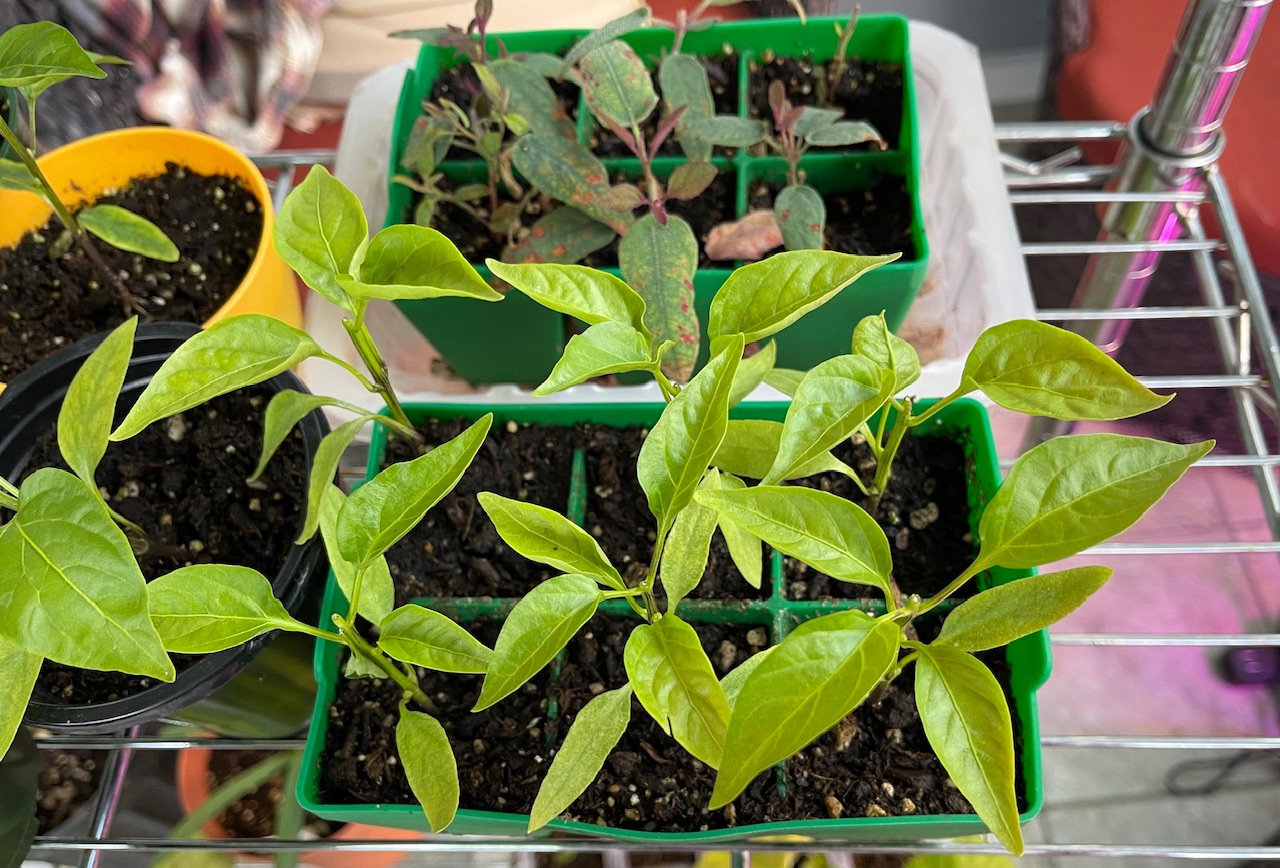
Pepper Seedling Update. 31 Mar 24.

 The peppers are looking pretty good. I wonder if it's too cool to have peppers outside even during the day (mostly 60s F) but I think the sunshine and fresh air are good for them


They've been getting the same Liquid Schulz house plant food as other plants.  I'm considering switching to a higher nitrogen but diluted Miracle Grow to boost them some more.  I usually use 1/4 teaspoon per 2 quart watering can.  My water is rain water, so salts are not an issue.

Eucalyptus Seedling Update. 31 Mar 24.

 I'm impressed that the Eucalyptus seedlings are easier than I expected.

First, the Silver Dollar" Eucalyptus cinerea, which were the second ones I planted.


These are all in their 4" pots now, in regular potting soil.  They are on the "plantmobile ", inside at night and outside during day.  I topped three for bushiness.  I might see if one or two will survive outside and grow into trees, so did not top those.

Second, the lemon bush Eucalyptus, Eucalyptus citriodora (AKA Corymbia citriodora).   These are a mixed situation.

The ones in 4" pots look pretty good.  I topped them a while back, and branches are forming.


The ones in the silicone six-packs don't look so great.


The leaf spots & leaves dying appeared shortly after transplanting them.  I don't know why.  Soil, light, temperature was the same.  Maybe it's because I divided some of those, so they had more root trauma.  Some seem to be growing again, so I'll keep taking care of them as I already am.

Espalier Apple Care And re-Grafting. 31 Mar 24

 I finished regrafting the Redlove Espaliers with replacement varieties that I know I like, and I know perform here.  Mainly Jonagold and Akane, a Japanese heirloom with Jonathan and other ancestry.

I tried matching scion / stock diameters but some were not in good places.  For a couple, I used a side graft.  For that, the scion is cut as a wedge, same as a wedge graft.  Then a slice is made into the cambium of a much larger branch, making sort of an ear.  The scion wedge is inserted and then wrapped as usual for tightness / cambium bond, and protection from dehydration.


Sorry about the bad photo.

I think this has as good a chance to take as any other.  The main things are timing, sap is flowing in under stock to feed callous / cambium growth and fusing, the scion is dormant so some fusing happens before it starts growing, warm weather for good growth but not too warm, and a good clean cut with as much cambium contact, firmly held together.  And protection from dehydration.

Farmers and gardeners have been grafting for thousands of years.  Such as, ancient Rome, ancient China.  It's a doable garden art.

I grafted the Redlove Odyssey with Akane.  I was aggressive at shortening growth, leaving shorter spurs and removing wayward branches.


The top tier is "Freedom" apple, which I'm leaving in place.  When (if) the grafts take and start making vigorous growth, I will cut off most of the long arms (or at least vigorous growth on those) of the tiers to foster most growth on the new grafts. 

It's not all loss. The top tier of Redlove Era is the ancient heirloom Blue Pearmain, which looks to bloom and bear for the first time this year.  The top tier of Redlove Odysso is Freedom, ditto.  Plus there are the two espaliers that are not red flesh apples.

Lower half HoneyCrisp, top half Gala (not pictured) and lower half Zestar, top half Rubinette.


I pruned those too, removing wayward growth and shortening spurs - especially if they don't have flower buds.  The Gala will have one more tier, on top.  I bent tall growing branches into position while they are suppple, and added bamboo extensions to the trellis posts.  Next it'll need a horizontal arm.


Mini Rose Update. 31 Mar 24.

 The rose I identified as "Sunmaid Kordana") - yellow mini-rose impresses me.  Here's the first flower bud.


They are all thriving.  This is the first time I've ever been able to grow them beyond the "new" stage. Currently, they are spending all of their days outside in full sun.  Admittedly a fair amount of that is rainy.  Temp ranging 50s to 60s.  Sometimes I bring them in at night.

Of the reds, here is the first ("Bi-Mart Rescue Rose" ).   I tentatively identified it as "Danika Kordana" but I'm not certain.  It seems to be more compact and redder growth.  Same treatment right now.  Also thriving.  It's worked hard and endured quite a lot.  Now it's time to recover and thrive.


Both are getting Schulz liquid house plant fertilizer with most waterings.  It's designed to be dilute so can be used each time, sort of like "fertigation".

The other, redder, red is still in its original soil.  I'm waiting for the blooms to fade, which is starting now.    I went through the patent list on the container.  The only one among those, that is a rich red, is named "Daniela".  It's complicated and there's probably no way to know for certain.  (such as, I also thought the yellow one might be "Aloha".)

These are meant to be sold as commodities.  Like, if you buy a red grocery store potato, it could be Red Pontiac" or " Red Norland" or "Red Something Else".  It's just sold as red.  I think, similar for these roses.

Here is the Kordana website.  It looks like it's intended for vendors, not gardeners.  Not much info, only a few of their many varieties.  It's interesting to read.  

Making Bone Meal. 31 Mar 24.

 I made another batch of bone meal.  It's easy but takes a little effort.  And some bones.


Even though I am vegetarian, I make all of Rufus's dog food.  The main source of meat is chicken thigh or legs, both of which are high-taurine which some dogs require to prevent heart disease.

I slow cook the thighs and legs overnight.  The meat just slips off the bones easily.  This is probably easier than other bones.

Bird bones are light and more fragile than mammal bones.  This would not work for cow or pig or sheep.

The bones need to be thoroughly dry.  During the summer, I dry them in the sun room, which becomes very hot.  Sometimes I use the oven after baking something, and it is cooling off.  The temp doesn't matter.  I don't leave them sit around damp.  They would become moldy or attract creatures.  If it's a while before they can be dried, they can be frozen in a freezer bag. This time, I was also making chicken heart jerky.  I cut the hearts lengthwise, and dry in food dehydrator 145 F for 12-hours.  Rufus likes them and they are 100% meat.  At the same time, I spread the chicken bones on one of the trays and they dried just fine.

Then I pick a nice afternoon to sit on the deck with an audiobook and a granite mortar and pestle to smash and grind the bones into bone meal.

It's difficult to find a good analysis of trace chemical composition specifically of chicken bone, on line.  Also, analyses may be for bone without marrow.  Bone meal in general is an excellent source of calcium and phosphorus.  I saw some suggestions they also contain magnesium in trace amounts.  The brown color is from the marrow, which I imagine contains iron and protein (nitrogen) and some fat.   The N-P-K is about 3-15-0 (Wikipedia) and calcium is about 12%.   

As for use, bone meal needs to be mixed with soil, not on top.  It breaks down over about four months, so now is a good time.   It's best used in acid soil (Pacific NW, west of the Cascades for example).  In Steve Solomon's book about gardening in the NW, he states the rains leach calcium from the soil, so soils here benefit from nitrogen supplement (no reference, just my memory).  

Various sources recommend about a quarter cup of bone meal mixed with the soil when planting rose bushes.  I did that.  Also in garden bed preparation, I add about a cup per bed (40 square feet) or 1/4 cup per 4 foot row then mix in before planting.


Friday, March 29, 2024

Stars Quilt, Beginning. 29 Mar 24.

 Im putting together a quilt kit for a repeat of this quilt.  The original pattern and instructions were by Lynne Goldsworthy in a supplement of Today's Quilter Magazine a few years ago.  Mine strayed quite bit from the published instructions, and so will this one will even more.  Lynne called this quilt "Pythagorus Theorem" because of the triangle calculations.

One challenge is that the instructions make use of fat quarters and newly bought fabric.  I am using what I have. Some is new, some is yardage, some scraps, some left over from jelly roll sets.

This instructions called for 72 diamonds, 2 1/2 inches wide.  I added more, so now it's 88 (I think).  Coincidentally, the first quilt book that I bought, years ago, had a diamond template exactly that size.  That made it go quickly.  Also, jelly roll fabric is 2 1/2 inches wide.


Jelly Roll Strip With Diamond Template.  Perfect size!


This pattern calls for 288 half square triangles.  I'm not certain if the exact size is in the instructions.  They are 2 1/2 inches square when trimmed.  I looked several times.   But there is a lot of text, so who knows?   Probably there.   The instruction calls for starting with larger pieces than I have, but I can adapt.

One way I can stream line a bit is to start with two six (6) inch squares.  Lay facing each other, draw lines corner to corner.  Then sew 1/4 inch both sides of each line. Small template is 2.5 inches which is what I want in the end  Here I should have put the line on the seam instead of the line.  These are scrap fabric.  It took me several tries to figure this out.


Then, cut so there are four three-inch squares, then cut on the lines to make eight triangles.


Open up, press seams open, and there are 8 half-square triangles.  They need a slight trimming, but not much.  It's less sewing, cutting, measuring, than individual half square triangles.  I misaligned some but these are scrap anyway.


I have a lot of 2 1/2 inch strips that will become half square triangles too.  Those need individual measuring, cutting, and sewing.

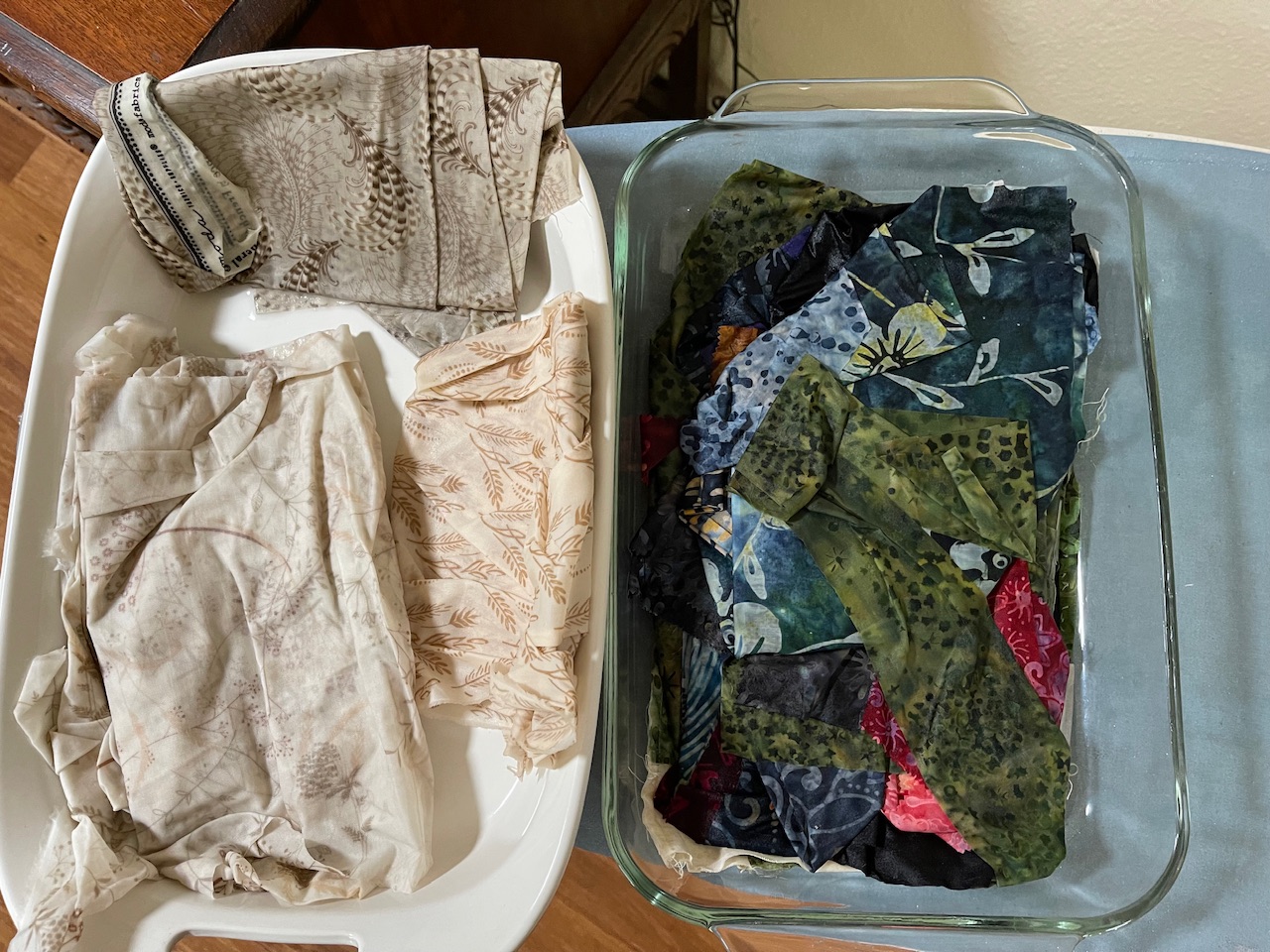
Especially for triangles and stars - which is this entire quilt - a lot happens on the bias.  Which means things can be more stretchy, distort easily, be uneven, and not match up.  Starching stiffens the fabric and stabilizes it.   I use starch concentrate.  It's cheaper and soaks into the fabric thoroughly, giving a nice stiffness.  I use the dilution for medium or medium-heavy.  I soak the fabric in the starch solution, then lay it out and press down to remove excess liquid.  I don't wring or squeeze.


Casserole pans work nicely.  Then I lay it out on towels to dry in a warm place.  It takes about a day.  I steam iron to flatten the fabric.  I'm not pre-washing,  That doesn't work for strips.  They unravel.  Plus, I want the final quilt to shrink a little when finally washed, for a textured, crinkly, sort of antique-y look.