Saturday, July 11, 2020

Grafts That Didn't Work. 7.11.2020

The vast majority grafts this Spring worked fine.  The apple - on  - apple were all successes, except for Pristine on Geveva 222. 

Pears on odd rootstocks generally didn't work out.  It looks like Bartlet-type on Chinese Haw will be OK.  The same pear on Serviceberry, Bud-9 with Winter Banana Apple, or Aronia, did not take. 

I grafted 3 chestnuts cultivars onto the Marisard seedling.  It may be too soon to know, because there might be delayed graft failure.  They all grew.  When I unwrapped Marivale, it still looked OK, but when I unwrapped Marigoule, the graft fell off even though there was a foot of healthy looking growth.

Cleft Graft of Small Pristine Graft, onto Geneva 222.  There was good growth, but it fell apart when unwrapped.  7.11.2020

Whip & Tongue Graft Marigoule Chestnut onto Marissard Seedling Chestnut.  It grew well but fell apart when unwrapped.  7.11.2020

Whip and Tongue Graft of Marivale onto Marissard Chestnut Seedling.  Looks OK.  7.11.2020

Saturday, July 04, 2020

Apple Grafts. Progress Report. 7.4.2020

These are the apple varieties that I grafted onto either Bud-9 or Geneva-222 highly dwarfing rootstocks.  Most are on Bud-9 but I tried to use Geneva 222 on ones that I thought might have too little vigor.  On taking of the tape, there was slight constriction of stem girth but not severe, and not girdling.  Going by memory, which isn't perfect, here is a list.

Here are the varieties that took and grew quickly:
Jonagold - most vigorous. (Bud-9)
Jonared - less vigorous (Geneva-222)
Gravenstein -less vigorous (that was a surprise) (Bud-9)
Winter Banana - very vigorous (Bud-9)
Black Oxford - very vigorous (Bud-9)
Macoun - somewhat vigorous (Bud-9)
Beni Shogun Fuji - less vigorous (Geneva-222)
Porter - quite vigorous. (Bud-9)

I tried a tiny graft of Pristine on Geneva-222.  This was the only cleft graft.  The growth was vigorous, but when I removed the binding tape, the graft broke off.

I tried a pear on Winter Banana intergraft on Bud-9.  That grew a little but died.
I tried pears on Amelanchier.  Those failed.
I tried pear on Chinese haw - that appears to have taken and is growing somewhat vigorously.

Apple Grafts on BUD-9 or Geneva 222.  7.2.2020

Healing Whip and Tongue graft on Bud-9.   7.4.2020

Healing whip and tongue graft, apple on Bud-9.  7.4.2020

Apple grafts on Bud-9 and Geneva 222.   7.4.2020

Wednesday, July 01, 2020

Some Daylilies that I grew from seeds, from hand-pollinated flowers. 7.1.2020

A few years ago I transferred pollen from daylilies that I liked onto other daylilies that I liked. I grew out some of the seeds. Here are a few of those hybrids, photos taken yesterday. They are quite nice.


Patch Grafts, Peach and Cherry. 7.1.2020

Here is one of the "Sunny Day" peach patch grafts that I did a week or two ago.  The leave has abscissed, leaving a green bud.  7.1.2020


A close-up of the same "Sunny Day" peach graft.  7.1.2020


Local Black Cherry Stick for bud wood.  7.1.2020

The bud patch that I cut.  Cambium is slipping nicely now.  7.1.2020

Fitting the black cherry patch to some first year growth on Surefire Cherry.  7.1.2020

Patch graft all wrapped up.  7.1.2020

Bee Forage Flowers. 7.1.2020

Over the years, I've tried to plant lots of forage plants for honeybees and native bees. Now that there is a successful beehive in the yard, that interest is renewed. Here are a few blooming now. I know that the vast majority of their forage comes from traveling around the area, with lots of dandelions, daisies, blackberries, and other flowers blooming. We also have some big areas of those on our two acres. I also think it doesn't hurt to add some of our own forage.
Bees like almost any herb.  This is cilantro in bloom.  7.1.2020

When garlic chives are blooming, they are almost always hosting honeybees and local bees.  7.1.2020

Lots of pollen here for honeybees.  The pollen sacs are filling up - rear legs.  7.1.2020

Probably not a significant source of nectar, but bees sometimes forage the daylilies.  7.1.2020

I planted these European lindens in 2012.  They are getting some size now.  Honeybees love them  7.1.2020

Linden flowers are quite fragrant.  7.1.2020

The lindens are buzzing with bees.  7.1.2020

This is a Greenspire European Linden that I planted in 2012.  I wondered if these would grow.  They did.  7.1.2020

Daylilies...7.1.2020

Many of the daylilies are blooming now. These are ones that I bought over the years.


Friday, June 26, 2020

Garden Updates. 6.26.2020

Miscellaneous notes.

I've been cleaning up my bearded iris bed.  It's kind of embarrassing how weedy and unkempt it became during the rainy season.  There was too much else to do.  Now I have a big cleanup to do.

In addition to weeding and cultivating, I'm cutting back the leaves and letting the rhizomes bask in the sun.  I have not decided yet about mulch, although in my heart of hearts I know it would help a lot with leaf spot and bacterial rot diseases.

I'm also culling,  If I think the flowers are ugly, I'm removing that clump. I'm also removing the ones that seemed highly susceptible to the cool wet season diseases, bacterial rot and leaf spot.  The newest reblooming varieties have been the most susceptible, and I culled most of them.  I kept a couple of the big lush modern non rebloomers for this time around, even though I think a couple of those are also too susceptible.  Next year...

Replacing those, are "rescues" from roadside "Free" rhizomes that I grew in separate nursery beds for a year or two, to see what they look like.  Those are nonlabeled, but one looks like Shah Jehan, another like Wabash, and there is a very nice white one and a plicata type with mauve coloration around the edges of the petals.  None of those seems particularly disease susceptible, and all are nice.  That let me decomission that bed in the easement, which I planted with wildflower mix, grass seed and clover.  I also moved into the iris bed, from a nursery bed in what is now the fenced vegetable garden, Monsignor, an apricot colored iris, and a purple one that is very large and nearly black.
Bearded Iris Bed undergoing cleanup for summer.  6.26.2020.
The chestnut trees are starting to bloom.  It's difficult to see the female flowers.  There are a few.  I'm hoping they will start to appear as the male flowers come into full bloom.
Maraval Chestnut in bloom.  6.26.2020

This is one of the chestnut grafts.  It's interesting that these grafts are blooming in their first year.

Graft of Precose Migoule chestnut on Marissard seedling chestnut tree.  6.26.2020

These are a nice summer squash. They are very good sliced, coated with little olive oil and seasoned salt, and cooked in the air fryer.


Peach Bud Grafts. 6.26.2020

So far the bud shield grafts that I did for Sunny Day peach on Lovell rootstock look OK. The earlier one abscissed it's leaf, which I think is OK. The bud is still green as is most of the shield. Im a bit concerned about the brown appearance on the edges of the shield, and hope that doesn't mean it didn't take.  The second one, 2 or 3 days younger, looks about the same as it started.
Bud Graft of "Sunny Day" peach on Lovel, about day #3.  6.26.2020

Bud graft of "Sunny Day" peach on Lovell.  I think this one is about day #6.  6.26.2020

Honeybees. 6.26.2020

It's been a few days since transferring the feral honeybee swarm to the top bar hive. They seem OK. One mistake I made with previous attempts, was I was too nervous about opening the hive. By not doing so, the honeybees built comb across the bars instead ofjust on the bars, and it became impossible to open the hive without making a big mess and ruining a lot of the comb.  This time, I want to do it right.  I opened the hive and examined most of the bars, with comb being built on about 6 bars now.  A couple have a fairly large comb although not yet filling the entire space..

Me at top bar hive, with newly made comb.  6.26.2020

Close up of comb with honeybees.  6.26.2020
Years ago when I was trying to support honeybees as well as native pollinators, I grew some milkweed from seeds.  It hasn't spread much, which is good, but grows nicely each year.  The honeybees like these fragrant flowers.  I also moved some milkweed to woodlot, which is too weedy for much growth of desired plants and is on my list to clean up.  Meanwhile there are these nice ones, which get no watering at all throughout the summer, and are under the fig trees.

Honeybee on Milkweed Flower.  6.26.2020

Honeybees also like alliums.  I have a lot of chives and garlic chive, which they like a lot.

Honeybee on garlic chive blossom.  6.26.2020

Honeybees also like linden flowers.  Again, when I was first thinking about bee keeping, I planted four European linden trees.  They are a nice size now, about 15 feet tall, maybe 20 (who knows) and just beginning to bloom.  This is nice timing.

Flowers on Greenspire European Linden.  6.226.2020
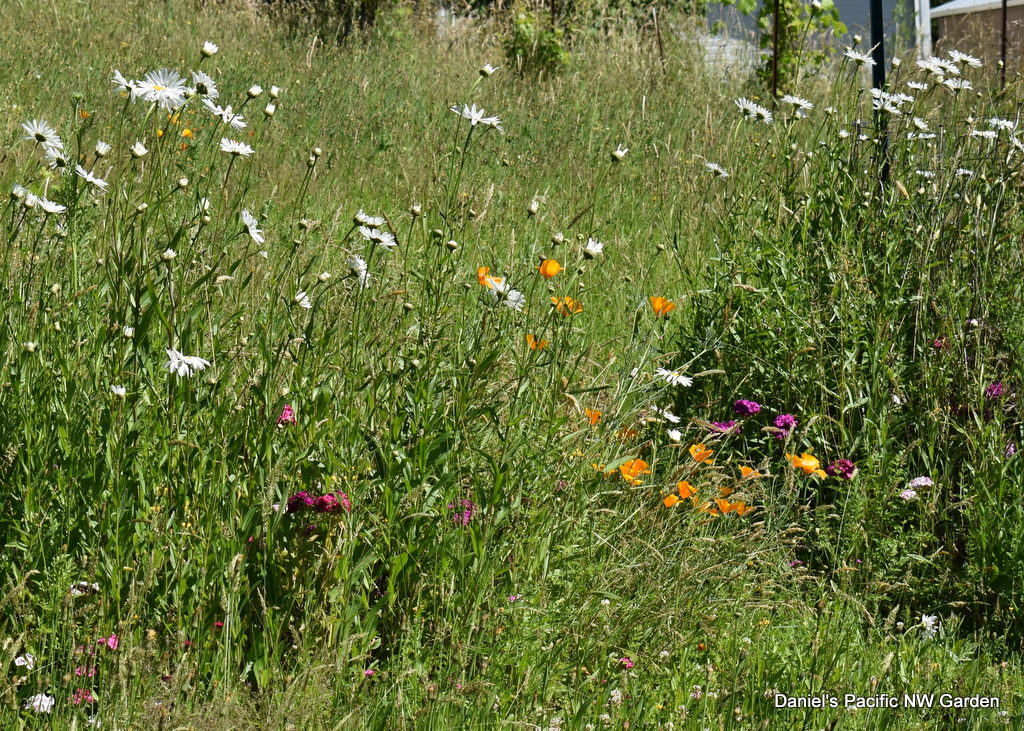
 Then there is the wildflower meadow.  This has devolved to mostly daisies and dandelions, with a handful of dianthus and California poppy.  Still, there is nectar and pollen to be had.  In other areas, coincidentally, we had decided only to mow the periphery.  In those areas there is a lot of white clover, as well as dandelions and daisies.  We also have some areas with lots of herbs, including a big patch of lavender, sage, and rosemary, and I grow a fair number of herbs.

Some of the neighbors are also using a minimal mowing philosophy, which may mean more forage for any bees in the area.

Wildflower meadow area.  6.26.2020

Tuesday, June 23, 2020

Honeybees. 6.23.2020

There was a swarm of honeybees on a bush in the yard. I cleaned up my old top bar beehive, put on the old beesuit, and transferred them to the hive.

I didn't know what to do.  First I made up a solution of sugar water to calm them down.


They were weighing down this bush, which was 6 feet tall but now touching the ground.


I trimmed off the top of the bush so it would be easier to handle.


Carried the swarm to the beehive.


Put them into the hive and close it.  Now I need to quickly read up on what I need to do. next.  I did give them a shallow pie-plate of water with rocks in it for them to drink, and the same with some sugar water.