Thursday, January 06, 2022

Adding Eggshell and Coffee Ground Supplements to Raised Bed Soil. 1.6.22

Now that the last raised bed has its full amount of topsoil, I want to enrich it with available amendments. I generally use compost (garden and kitchen source), coffee grounds, eggshells, wood ash, and leaves. The other raised beds have had all of those added already, either through the year last year or in the fall and winter. This last one, just completed, has only some wood ash at a somewhat deeper level (1 foot deep), and the new supplement of biochar mixed in to the top few inches. 

 My attitude is that not a lot is better than too much. For example, everything is growing well already, so the soil it pretty much OK and we want it to stay that way. Too much of alkaline supplements could result in soil too alkaline for good growth. On the other hand, gardening removes some minerals and the action of time, tilling, bacteria and fungi, degrade soil structure and impede drainage and root growth as the soil is used over the years. Rain also leaches calcium and some other minerals. 

 The most deficient mineral is Calcium. My soil tests always confirm Ca deficiency. Steve Solomon in his books about growing vegetables west of the Cascades, also discussed adding a lime agent, especially dolomite lime that also contains magnesium. Either wood ashes or lime will correct soil acidity in the right amounts, and add lime. Wood ashes also add other minerals, especially potassium (Mostly Ca,then K, then Mg, P, S, Fe and Na). Source. Source. UC Davis recommends not more than 5# per 100 sq feet. I use under 1 pound per 4 x 8 foot bed (32 sq feet). 

 The internet is an excellent source for myth and unsupported non-info, and the idea of adding eggshell to garden is a good example. lots of sites claim eggshells will deter slugs (in my experience, they don't), keep deer away (nope), increase soil calcium or dont (they do). They usually miss that along with eggshell there is the membrane, a source of some nitrogen and some sulfur. A lot depends on preparation and how much and other factors. The best research that I've found so far comes from Iowa, which is a farming state and has massive egg production, resulting in massive amounts of eggshells? There, farmers do plow eggshells into their soil, and corrected for calcium carbinate content, they work as well as agricultural lime. source.   There is also some research on eggshell as a detoxifier of heavy metals in soils.  Apparently, the metals bind to the eggshell and become unavailable for plants to take up and leave traces of in food.  I'm not really concerned about that, but the eggshell is porous, and may be a site for ion exchange for other minerals, and a place for soil microbes to proliferate and do their thing, which I think is probably good.

All that considered, I save eggshells and let them dry out. I usually crush the dried eggshells by hand, but lately I use the food processor to grind them more finely. I let coffee grounds dry out too, for easier handling. I'll look for more about them later, but basically I add them as a nitrogen source, secondarily as a potassium source, and a matrix for soil bacteria, fungi, and food for earthworms. 

 I added about a pound of ground eggshells, and 2 pounds of semi-wet coffee grounds. That's all until time for planting in two months. I'll rake them in when it's not raining. There is no hurry, this bed wont be planted with anything for two more months.

Tuesday, January 04, 2022

The Final Raised Bed Is Filled with Soil. 1.4.22

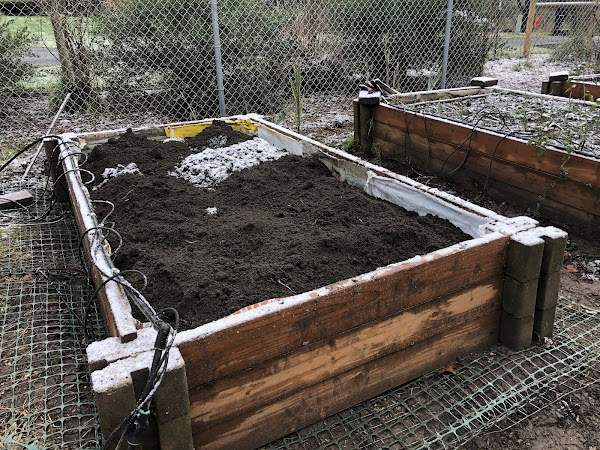
Today was drizzling but otherwise OK. I become a bit anxious when there is an unfinished project. So, I filled the last raised bed the rest of the way with top soil. Given how much it's rained and snowed this week, I want to think that the lower layers are all settled, so the top level settling might be minimal. Before adding more soil, I dusted the previous layer with wood ash and the cremated remains of chicken femurs. Those came from the chicken thighs I use to make Rufus's dog food. If the uncremated bones are used, they don't degrade all that fast, and can be dug up when planting and digging. So I let them dry out, then throw them into the woodstove whenever I burn some logs. Then the bones become very brittle, crumblng apart with a finger touch, and most are just ash. Bone ash adds Calcium and Phosphorus, and wood ashes add Calcium, Potassium, Magnesium, and some other minerals. They are alkaline but not quite as much as lime and I the soil tested acidic anyway. So it's a beneficial amendment or at least no harm done. When I fill, I empty the buckets so he ground is uneven, with mountains and valleys. Well, maybe for a hobbit but it is uneven. That way, after mixing, there is no distinct "lasagna" layer. Then I added biochar all over that - the black appearance is biochar.
Then I used the garden claw hand tiller to mix it in, then I used a shovel to mix some more. Then I used the garden rake to mix and smooth.
Next I'll add about a pound of crushed eggshells to the top and mix those in, and a layer of leaves Then it will settle and mellow and earthworms will purposefully tunnel through all of that, leaving trails and starting to built good soil structure. Then, I'll lay the paths between and around all of the raised beds. I'll discuss eggshells and what university agricultural research says about them with that post. There are lots of people on the internet repeating what others say, positive and negative. Almost none of them report actual research.

Thursday, December 30, 2021

Snowing like Crazy! 12.30.21

Amazing how much it snowed. Not cold enough so far to cause any damage. Still the coldest months to come. We will see how it goes.

Tuesday, December 28, 2021

My Grandparents in their Garden. About Mid1960s.

This is my favorite photo of my mom's parents. They lived in Western Illinois (Mt. Sterling). It's diffficult to see the garden in this photo. My grandfather, Glenn Wilbur Alcorn, always grew sweet potatoes, tomatoes, potatoes, sweetcorn, turnips, dahlias, zinnias, balsam. I'm sure those are dahlias to her right and balsam to his left. I recall my mom telling me that his doctor told him to garden, after he had a heart attack. I don't remember if my grandmother, Ivy Icenogle Alcorn, also worked in the garden. I'm thinking she must have, but my recollection is more of him.

More pH Tests. 12.28.2021

This is the pH of the bed that currently contains garlic. This is the only raised bed whose soil is entirely from our property, having been salvaged from a neighbor's road building on an easement on our property. This soil color is dark brown, compared to the purchased topsoil being black.
This is New Raised Bed #1. This time I'm doing it right, soil:distilled water 1:1 and letting it sit in a tall jar overnight to settle and clarify. I also did that with the garlic bed soil.
This is comparison of distilled vs. tap water. I assume the pH paper is calibrated with distilled water, since that is what they direct us to use, and I did. D for distilled and T for tap. Our tap is well water run through a purifier and softener system. It's not as acidic as distilled water.
I feel much more reassured about the adding lime and/or wood ashes. New raised bed #1 (and #2) soil is from the top level of the beds, which is soil I have amended with compost, lime, wood ashes, las year. It's certainly not alkaline, and the garlic grew very well, so I think I have a good system going.

Monday, December 27, 2021

Topsoil pH and Chemical Tests. 12.27.21

I used a home test to check the pH, N P K content of the topsoil I've been using to fill raised beds. This is a test of the un-amended soil, nothing added. pH
Nitrogen
Phosphorus
Potassium
pH, using pH strips and dilution 1:5 to make it readable.
I think these are a little difficult to interpret, but maybe OK. If Im reading correctly, pH using the liquid reagent is about 6, maybe 6.5. Nitrogen looks depleted and both phosphorus and potassium look deficient. By the pH strip method, the pH is about 6, maybe 6.5 so similar to the liquid reagent test. I'm not surprisd the topsoil would be depleted. Now I feel more comfortable fertilizing and adding a liming agent (wood ashes).

Sunday, December 26, 2021

Fungi. 12.26.2021

There are mushrooms growing all of the time. Last winter I spread a layer of tree chips in several areas, often on top of a newspaper layer. The newspaper is completely gone now, and the woodchips are starting to disappear. Meanwhile mushrooms continue to pop up. They like growing in those wood chips.
The benefits of fungi are legion. The soil should be interlaced with fungal mycelium, for soil health and therefore plant health. Often, I remove some mushroom caps and place them on the raised bed soil the get them started in the new soil.

Winter Day. Raised Bed. Deer. Rufus. 12.26.21

It snowed again. Rufus got to take a walk. He likes to snoop. He sticks his nose under the snow, then snorts like a horse. Then he sticks his nose under the snow, then snorts like a horse. Then...
There were some deer between the woodshed and the woodlot. They like it there. It gives them a chance to see if I leave the garden gate open so they can eat the remaining plants and fruit trees.
They grew nice and big, munching on my fruit trees and flowers and veggie plants. I set a goal of not more than 10 to 15 buckets a day in the raised bed. Today I added about 15, lost count. More is too much for me. At this rate, it will be filled within two more weeks. Next layer is compost from a year-old compost heap, then what I imagine will be the topmost layer of topsoil.
Rufus supervised.

Friday, December 24, 2021

Saving Squash Seeds. 12.24.21

These are seeds from the Pink Banana Squash that I hand pollinated. When I gutted the squash (like making sausage, gutting a squash is not for the squeamish), I rinsed the seeds and then left them to dry for a week on newspaper. I stirred them a few times so they would dry thoroughly.
The bits of newspaper stuck to the seeds are harmless and I don't remove them. This is enough Pink Banana Squash seeds that, if I planted them all, and they all made squashes, I could feed a moderate sized city.

Garden Raised Bed 1/2 Filled With Soil. 12.24.21

Due to space constraints, I have to fill this raised bed, bucket by bucket. I tend to overdo the work then regret it and get mad at myself. I have all Winter, and Spring if needed, before it gets planted with the main crop. This year, a community of moles moved in under the previous raised bed and had big mole parties. I think they were mole weddings, or maybe mole political rallies. They dug up the paths and mixed dirt with the nice thick layer of tree chips I had as a pathway. So the pathway is useless now. So, I dug off the top layer, which made the bottom four inches or so of the rebuilt raised bed. Eventually the tree chips will compost themselves and just be soil. Then I covered that with about six inches of new topsoil. Then a bag of leaves, which wont add much volume but will add a little organic matter and feed the soil fungi and earthworms. Now I've started adding the top layer of topsoil. When completed, the bed is 18 inches high, a good height for accessible gardening.
I'm ahead of schedule. If I set my goal for a half dozen buckets a day, it will be done in January. Then I'll put down a barrier in the pathways and cover with something that stays reasonably clean and comfortable to work on.