Overall I'm very happy with the barrel planters.
Thursday, April 22, 2010
Kitchen Garden: in the Barrels.
Overall I'm very happy with the barrel planters.
Labels:
barrel planter,
kitchen garden,
multiplier onion,
pepper,
radishes
Sunday, April 18, 2010
More orchid lithographs
James Bateman was a landowner and horticulturalist, lived 1811-1897. He created the famous gardens at Biddulph with the aid of his friend and painter of seascapes Edward William Cooke. Bateman published the largest orchid book in his time. Most, but not all, lithographs on this page are from Bateman. All of these photos are from wikimedia commons.Bateman's book is available here, at botanicus.org.
The lithographs are especially beautiful. Many show the entire plant, not just the decapitated flowers. The lithographs were as much about understanding the biology as they were about appreciating the beauty. Most orchids grow on tree branches, although there are nonepiphytic species, so drawings that include tree branches and exposed roots are more revealing and realistic than pictures of blossoms.
Bateman corresponded with Charles Darwin, who was fascinated by orchids (Darwin wrote a monograph on the ways that orchids interact with insects to ensure cross pollination). In January 1862 while researching insect pollination of orchids, Charles Darwin received a package of orchids from the distinguished horticulturist James Bateman, and in a follow up letter with a second package Bateman's son Robert confirmed the names of the specimens, including Angraecum sesquipedale from Madagascar.
The orchid explorers must have had a powerful sense of adventure. Those who grew them back in their own greenhouses, must have been happy to escape into their own world, as well. I think I understand, and would like that as well.
Oncidium chrysothyrsus
Oncidium insleayi or Rossioglossum insleayi
Galeandra Baueri
Labels:
Cattleya,
Charles Darwin,
Dendrobium,
Oncidium,
orchid
A minicattleya
The leaves aren't the nicest looking, a bit mottled. I'm concluding that is often the case for orchids. The older leaves may well be 1 or 2 years old, possibly older. So they can't always be expected to be perfect.
On getting it home, I turned it out of the pot and cleaned off the roots. Compared to the Cattleya walkeriana, this plant had very healthy looking, plentiful, roots. I cut off a small number of dead-looking roots with a sterile scissors. I potted it back into the original container, but with fresh bark mix. Washed slightly warm water through the medium, then a watering of weak orchid supplement.
More:
I asked on gardenweb if anyone could identify this, orchid forum. They came back with Potinara Achung Yoyo "Little Goldfish". I'm certain that's the correct identification. Here's a google image search. It's identical. With the renaming of many potinaras, this may more correctly be a Rhyncattleanthe Ahchung Yoyo.
Saturday, April 17, 2010
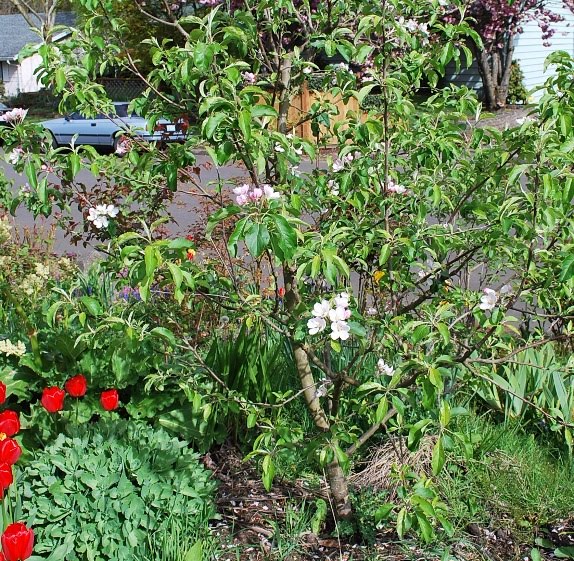
Fruit trees: Apple blossoms, tart cherry blooms, pears have set.
Technically, this counts as "Kitchen garden" but I'm keeping the "backyard orchard" in a somewhat separate category. Plus, apple blossoms are ornamental in their own right, even if the trees don't bear fruit. Same for the tree forms, which become increasingly beautiful and gnarled with age, starting fairly early.
Asian pears have set fruit. This is the 3-variety tree planted Spring 2009.
Second variety, different coloration. All 3 have set. Cool! They'll need thinning in a few weeks, I'll keep them to one fruit to a spur.
Golden Delicious. I think this was a semidwarf, not a minidwarf. It is too vigorous. This is the first year with significant blooming. Last year there was one cluster of flowers. This is the best blooming year ever! Cool!
May not look like much, but this was just planted last month. This is Karmijm. We'll see how it looks next year, and the year after. If it blooms, I really should remove any potential fruit, to allow for growth this year. Same for the new Honeycrisp, which as discussed before was little more than a stick with a root. That one will definitely not be allowed to set any fruit this year, if it blooms.
Jonagold. This is becoming a handsome specimen, with beautiful flowers. Last year was quite fruitful. No every-other-year bearing in this backyard-orchard-culture 'orchard'. About 6 ft tall.
Liberty. Also increasingly beautiful, year after year. Still only about 5 ft tall.
Northpole. Beautiful specimen! Last summer, fall, winter, I pruned it right, finally! This year I intend to be more diligent about protecting the apples from insects (little socks for the apples), and trim to one apple per spur, and pick them when ripe!
"Surefire" tart cherry (pie cherry). I planted this tree late winter, 2009. It's blooming. How cool is that! Probably not enough this year for a pie, but assuming they set, there'll be enough for a good taste of cherries. Maybe we'll get a pie from in in 2011, at this rate!
This little tree needs a stake placed before the roots get growing too much, so that I don't damage roots. All minidwarf apple trees need a stake for support.
I need to move the stake so that the tree doesn't lean so much. Not a problem now, but she apples weigh it down, I'd like for it to be better balanced.
The Lilac Dénouement
Lilacs can be slow to bring into bloom. Most of these were either from small, bare-root plants, or from tiny starts that probably originated from tissue culture or cuttings. These have been in the ground here at least 4 or 5 years. Earlier, I gave them a boost of fish emulsion, hoping that it would stimulate growth for next year. The older lilacs have bloomed for a few years, but this is the first time for several. Our intent, was a blooming hedge for some privacy. They are not yet to that stage.
Nice purple. Fragrant.
Nice white. We cheated - it was purchased last year at the Lilac gardens, and was already in bloom at the time.

I've been carefully pruning this lilac to reduce height. Lat year it was 3 feet taller, with the flowers out of reach. I'll take of a few of the taller stems this year as well. It might be a good time to do so now, with the flowers kept as bouquets.
This shrub was probably 15 feet tall, maybe more. It was more tree, than shrub.
Subscribe to:
Comments (Atom)