Sunday, October 07, 2012

Moving a young, volunteer maple tree

This maple grew up in a border, at my house in Vancouver. No room there. I decided to move it to the place in Battleground.

This takes me back to when I was a boy. Often a neighbor or family member would have a volunteer tree, and give it away to someone who needed a shade tree. It's a nice memory.  People should do that now.  It would be neighborly, and promote successful, locally adapted species and varieties.

I guess most trees now are clones, grafted to seed-grown rootstocks. Then grown in field-nurseries.  Then bare-rooted, shipped, and sold, or bare-rooted, shipped, and sold to big box stores or nurseries, to be resold. Nothing wrong with being a clone, but it means the tree is probably shipped from a distance, the variety or species may not be locally adapted.  I've seen tropical species sold here.  They won't survive.  The lack of genetic diversity gives propensity for widespread disease, and loss of mature specimens, years later. I'm guessing that a tree on its own roots is more vigorous, but I don't know that.

I have also read, starting with a small tree, it will adapt quickly and surpass trees that were planted at much larger size.  This tree is now plated about 25 feet from the red maple, we planted a few weeks ago.  So we can have a "competition".  Will the little tree catch up to the big one?  Not a fair competition.  They are not identical varieties.  This little tree may or may not be a "red maple".  Acer rubrum.  The leaves look more like red maple than Norway maple, Acer platanoides.   There is also Acer macrophllum, the indigenous "Big Leaf" maple.  This does not quite look like those, either.  Time will tell.

As with other trees, I chose a generous distance from the tree and sliced vertically, making a circle around the tree.  This is a small tree, about 3 feet tall.  I think it sprouted from seed last year.
Continuing the circle.  One side is a short, retaining, stone wall about one foot high.  That made digging easier.  I did not have to dig on that side.
Then the trench, dug farther from the tree.  There didn't turn out to be much root.  I don't think any roots were cut or broken.  That will make for easier adjustment to its new environment.  This area has been enriched with lots of compost.  Digging was easy.  It's been dry for most of the summer.
I placed the tree into a plant container for transport.  I was not able to plant it last night.  So I watered it thoroughly.  Holes in the bottom prevented water-logging.  No wilting at all.   Looks as good as it did before digging.
Now in the ground.  I've been reading, it's better to plant trees at slightly above ground level.  That makes for better drainage.    It may be an issue for compacted soils.  This hole drained very quickly so it is not compacted.  I usually plant bought trees at approximately ground level, as close as I can determine.  It can be difficult to judge.  It's not rocket science.   This tree was "happy" choosing it's own level, so that's were I replanted it.
Filled in, watered, mulched with compost.  Now we await fall.

Spider Web

This morning.  The spider is your friend.

Roots, one month later

I planted this little, container-grown pine about one month ago. Already I saw it was a bad choice of location, and moved it.
Lots of little roots, a half inch long. The soil just fell away. I tried to move with a bigger soil clump but it fell off. I don't think the roots were damaged. It's nice to see that they started growing so fast.
Not the same pine as above, but treated in the same way that I treated that one, initially. This is a bush-type pine, mugo pine. I like pine trees a lot. I don't know why. A disadvantage of buying late in the season, is the roots wind around the container. The circle of roots does not allow for spreading into surrounding soil, weakening and potentially killing the tree, some time down the road. When they encircle this much, I make multiple cuts to discourage encircling and allow new root growth in an outward direction, into the new soil.
I pull away roots that are no longer connected to the plant, and gently spread the cut parts to prevent the "pot in soil" effect. I think it will recover and grow just fine.

Saturday, October 06, 2012

Onion and Chive update. Raised bed.

Already, the Chinese chives are filling in with new leaves, stout and firm. The smaller, finer "Illinois rescue" garlic chives are filling in faster than the Chang Chun culinary Chinese chives.  The Egyptian Walking Onions have many new shoots as well - some 3 inches tall.  I think about 2/3 have started growing above the soil.  Fast. Both the bulbs and the topsets are growing fast. There are 2 bunches of cilantro that I planted a week or two ago.  Almost ready to eat.
The Yellow Potato Onions are sending up new shoots.  That's about 2 weeks?  No garlic up yet. I'm not greedy, they will grow in their own time.

Moving a big forsythia bush

This bush was in a bad place.  Dry, north side of the house, shaded on 3 sides.  It was droopy and not enough room.  I grew it from a cutting about 7 years ago.  This bush had branches too tall for me to reach the top, so about 9 feet tall.  But all of the leaves were wilted. They have been repeatedly wilter most of the summer. I don't water it enough.

Doesn't look great, but on planting and watering, the few remaining leaves perked up nicely. My theory is that forsythia is so tough, and cuttings root so easily, and it does have a good root mass. So I think it will have a set back, and of course won't bloom next spring. But I think it will establish and be a nice bush by next summer. Pic to add tomorrow after it has the cool night to soak up water. Added the next am:
The forsythia leaves perked up nicely. I think it will do OK.

Moving a 4 year old cherry tree

Rain is predicted for next Saturday. Nights are in the 40s to 50s, days in 70s to 80s. Leaves are beginning to change color and drop. So I thought it would be OK to move this 4 year old Almaden Duke cherry tree from the yard in Vancouver to the yard in Battleground. It was quite a job.
Before digging.   I watered the tree thoroughly 2 days ago.  It wasn't getting watered much this summer.  There was a handful of cherries this year.  good.
Starting to dig.  As with the ginkgo, vertical slices about 2 feet from the trunk.
Then dig further out, making a moat.  Then slicing under the tree.  Slicing the soil, as deep as possible, not prying upward.
Then, as the tree falls to one side,  easing a tarp under it.  I did not lift, but rather wedged the tarp under the tree.  Then pulled on the tarp to move the tree.  At the truck, I lifted using the tarp.  I covered the tree with another tarp, along with a shrub and another smaller tree, tied it all down, and drove it to battleground.  It wasn't as good as it sounds - wind blew under the tarp, resulting in some dehydration of the tree.
Here's the hole.  I hosed down the tree and kept it covered until ready to put into the hole.  There are two mole tunnels into this hole.
I'm tired of moles digging into the newly planted trees.  I don't know if they actually do harm.  I'm also tired of me not doing something about it.  So here is a lining of chicken wire.  It should rust away in a few years.
Cherry planted.  A bit droopy.  I don't know if that's the wind effect, which didn't affect other trees that I moved, or maybe cherries in leaf just don't move well.  After soaking, it's a little less droopy.  Still, it may lose leaves, and I may not know until next year if it survives. Added the next morning:
The leaves did perk up. Not 100%, but much better. I think it will be OK. * The mole screen did seem to annoy and frustrate the mole. He/she built a new mole hill right at he screen, where the tunnel was blocked. I don't mind the moles. They eat grubs, so they have a beneficial role.I just don't want them to damage the young tree roots. It's also annoying when they pile soil on top of the mulch. When the rains start, I'm guessing they will concentrate on the newly moist soil of the lawn, and stay away from my little fruit trees.

Sunday, September 30, 2012

Brief update

No pics today. Today we had 3 figs from the Sal's fig tree that I moved this summer to Battleground. The figs were slightly different from Hardy Chicago. A little "richer" however that is defined. More juicy. Skin was not as dark, but flesh had more red coloration. It's not a fair comparison - different location. I'm glad it survived the move even in the Summer and provided some figs. I planted some plum seeds, Hollywood plum, among the shallot rows. They are labeled. This way they can stratify over the winter. Just for fun. I planted some chinese chive seeds among the plants. That should help fill in the gaps, if they grow. Fall planting has the risk of not growing at all, or growing but the tiny plants not surviving the winter. If so, not much loss. I saved lots of seeds this year. I stuck daffodil bulbs in molehills. I read that moles don't like daffodils. I did that only where the mole(s) dug too close to my little fruit trees. Rain is postponed another week. Maybe it's going to become a desert here? Watered all of the new tree and shrub transplants, and the raised beds.

Thursday, September 27, 2012

Figs

Now it's time for more Main Crop figs. Lots of variety now.
The biggest ones are the NoID Vancouver fig. Likely Brunswick. The brown figs are Hardy Chicago. The black figs are Petite negri. They are all wonderful.
The green ones are Lattarula.

Bulbs, Deer ResistantT

These were labeled as deer resistant. A wild tulip. I read that deer like tulips, but maybe not the wild one? More allium. Two varieties of grape hyacinth. If the deer don't get them, will the moles? I planted some around each of the new shade trees.

Transplanted Trees. One Week Later.

THey are not as droopy as I expected. In fact, they seem just fine.
The Stanley Plum. Not a single leaf has fallen. I watered this, and the other trees, today.
Indian Peach. I was sure I killed it. Not droopy, no wilting. So far, so good. I think once it's past the first week, it's less to worry about.
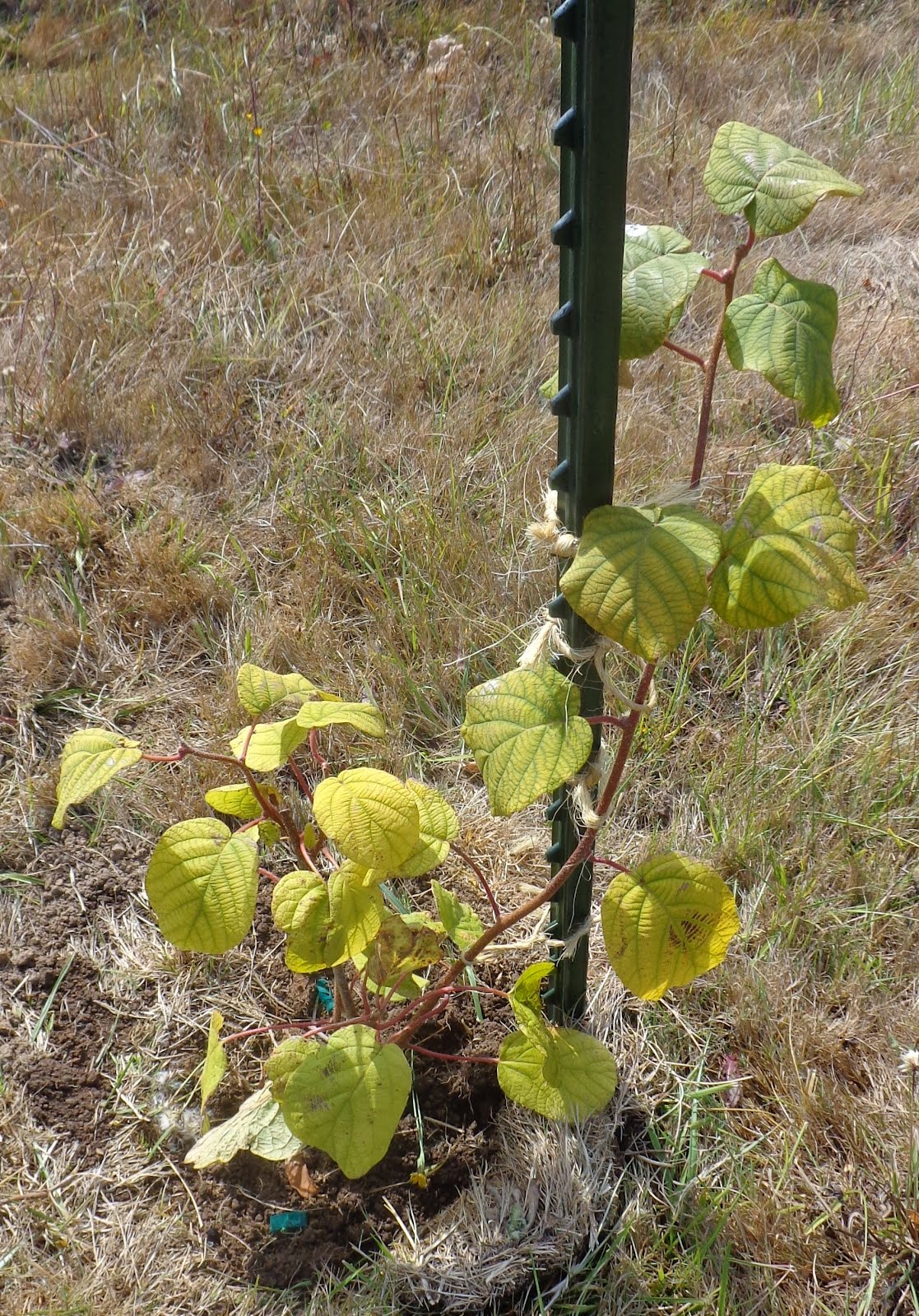
Not a home grown transplant, but it needed to go somewhere. Blake Kiwi. The start of a Kiwi vinyard. More, later.
The ginkgo. No more droopy than it was before. I think it will do OK.